
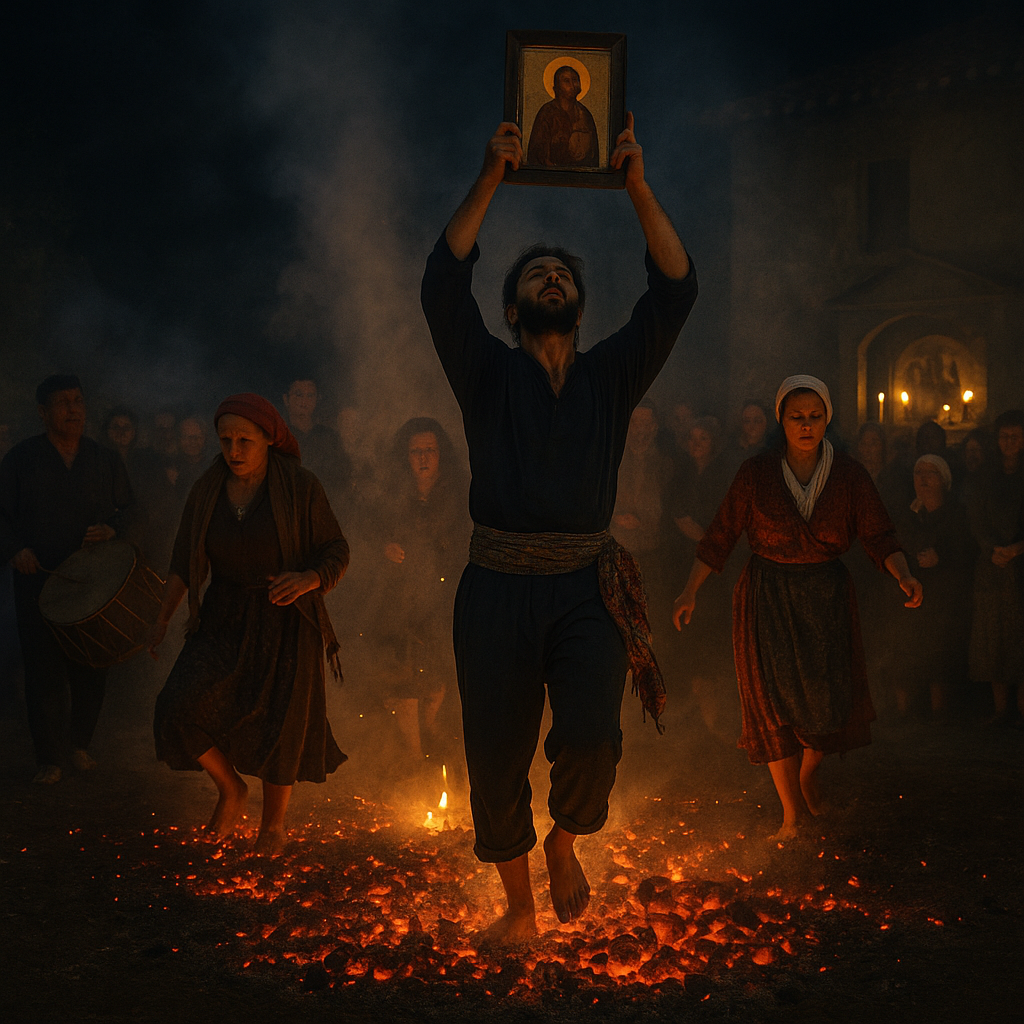
When speaking of Greek customs and traditions, Anastenaria is one of the most peculiar examples. It is a traditional, ecstatic ritual in northern Greece that takes place on May 21st each year, the day the Orthodox Church celebrates the saints Constantine and Helen. Sustained by music, dance, and trance, the participants walk barefoot over red-hot coals.
This seemingly inexplicable ability to endure extreme heat has long fascinated outsiders and raised questions about humanity’s hidden resources.
Today, the phenomenon has been demystified by modern science, and the firewalking itself is no longer considered a complete mystery. It has even gone so far that Western experience companies sell it as part of teambuilding activities and in courses in personal development.
Nowadays, anyone who wants can buy themselves an experience and walk barefoot on glowing coals. At the same time, it is of course not a risk-free activity. There are plenty of testimonies of people actually getting burned during this type of firewalking.
However, it is still deeply fascinating that this act can fundamentally be traced back to a living ritual that has been ongoing for thousands of years. Within the Anastenaria cult, the firewalking is not a modern gimmick, but a tradition carried through the centuries from generation to generation. In 2009, the ritual was also inscribed on UNESCO’s Representative List of the Intangible Cultural Heritage of Humanity.
Twenty-five years ago, in May 2001, the undersigned published a feature article in the newspaper Metrorama Athens about this ritual. The text depicted the ritual and the phenomenon of akaïa (ακαΐα), a concept perhaps best translated as incombustibility or thermal immunity.
The text aimed to present the ritual both as a living tradition and as a historical phenomenon. The headline was: “Δοκιμασία στην πυρά της πίστης” – which can perhaps best be translated as: “An ordeal on the fire of faith“. The original article (in Greek) from Metrorama 2001 is available as a PDF download at the bottom of the page.
An ordeal on the glowing bed of faith
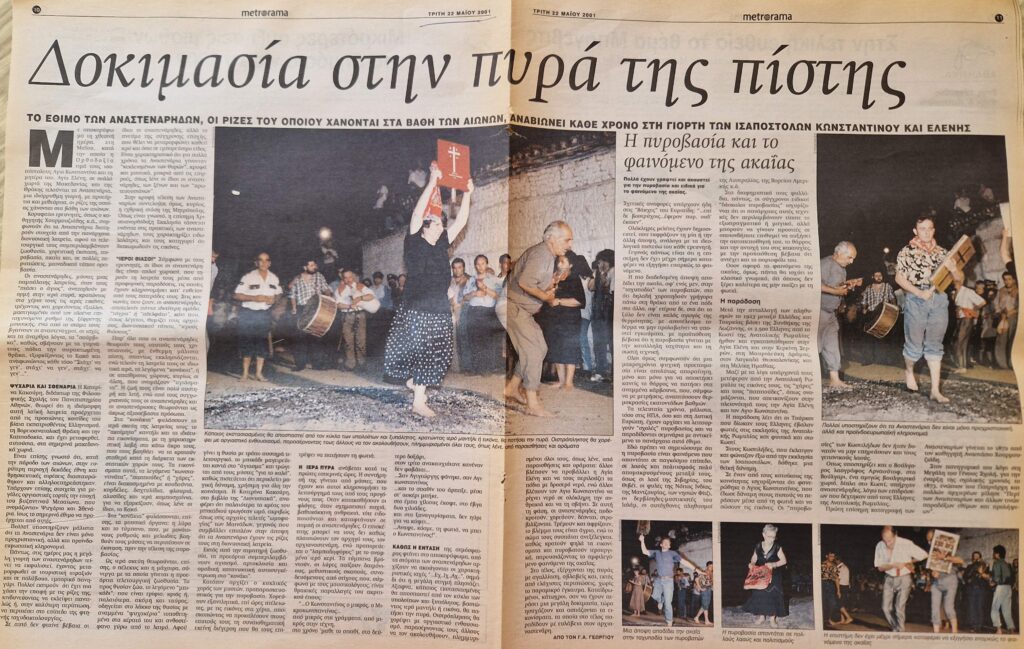
The Anastenaria tradition, whose roots disappear far back into the mists of history, is brought back to life every year during the celebration of Saints Constantine and Helen.
Tuesday, May 22, 2001 – By Georgios A. Georgiou
On May 21, the feast day of Saints Constantine and Helen, Anastenaria is brought to life in several villages in Greek Macedonia and Thrace. It is a distinctive ritual tradition whose roots disappear far back into the mists of time.
Prominent folklore scholars agree, however, that Anastenaria has preserved elements of the ancient Dionysian cult. The rites include animal sacrifice, ecstatic dance, firewalking, akaïa (incombustibility), and rituals reminiscent of the ancient maenads’ ecstasy.
The firewalking Anastenarides appear as contemporary mystics in an ancient cult. When they are finally filled with the saints’ power after long ritual preparations, they step into the bed of glowing coals. Holding the icons in their hands, they run and dance ecstatically, driven by the increasingly fast and wild music.
Deep sighs, ritual cries, and incoherent words are heard from them as their bare feet step onto the glowing bed of coals to drive out evil, while they repeatedly chant their traditional prayers for prosperity and protection.
The origins of Anastenaria
Scholars believe that this unique folk cult originates from the ancient homelands of northeastern Thrace and Cappadocia, from where the population was later violently expelled, and that the tradition has been passed down in unaltered form to today’s northern Greek villages.
It is also known that dozens of people and religious sects have crossed paths and influenced each other in this broader geographical cultural area over the centuries. Furthermore, there is evidence that major orgiastic festivals called Psycharia and Sthenaria were celebrated during the Byzantine Middle Ages. Today’s custom may be linked to these.
Firewalking as a rite for healing, initiation, and faith is a global phenomenon that has been practiced for thousands of years by widely diverse cultures worldwide, from the Pacific Islands and Asia to parts of Southern Europe. This global pattern strengthens the theory that Anastenaria may fundamentally be a Proto-Indo-European heritage.
Firewalking as a commercial experience
In our time, however, the great tradition of the Anastenarides tends to be diluted, as it has increasingly been transformed into a tourist attraction and a noisy, commercial market. Many judge that the ritual has lost touch with its roots and risks dying out completely, or, at best, being reduced to cheap entertainment and magic tricks.
This is, of course, not the firewalkers’ own fault, but rather a reflection of the modern zeitgeist that seeks to turn everything sacred into a commodity. It is telling that for many years, Anastenaria was held behind closed doors – hidden and secret, far away from external influence and the eyes of outsiders.
However, this tradition was largely concealed due to the church’s hostile attitude. The official Orthodox Church has always opposed the firewalkers’ practices, branding them as pagan and accusing the practitioners of ridiculing the holy icons.
The initiated society
According to scholars, the firewalkers themselves are simple villagers who preserve their cult through oral traditions, which they have inherited directly from their ancestors. In the communities where they live, they always constitute a distinct group, an order or a brotherhood, which is said to resemble the ancient sacred societies of the Dionysian type.
Although the practitioners view themselves as deeply devout Christians, they rarely attend church. Instead, they practice their cult in special rooms in their own homes, known as konakia, or out in nature – usually in sacred groves and at places they themselves consider hallowed and call agiasmata. Their lives are characterized by strict discipline and simplicity, and they are regarded as deeply respected individuals in the villages.
In the konakia, they keep the cult’s sacred objects: the “ever-burning” oil lamp and the distinctive icons with their characteristic handles underneath, which make it possible to hold them firmly during the ecstatic dances. These icons are called “konstantinata,” “grandfathers,” or “gifts of grace.” They are adorned with small bells, ribbons, rings, coins, chains, and holy rosaries – objects that, according to the practitioners themselves, help to drive away evil.
The sacred musical instruments are also kept in the konakia: the lyre and the drum, whose monotonous rhythms and melodies help the participants fall into an ecstasy before the dance over the glowing coals begins.
A special axe and a knife are also considered sacred objects, as these are used in the ritual animal sacrifice that precedes the celebration. The animal to be sacrificed – the so-called bikadi – is usually a lamb or a ram, but in the past, it could also be a bull.
The animal is led to the sacrificial site with lit so-called “soul candles” attached to its horns and a wreath of flowers around its neck. After the sacrifice, which takes place in a strictly ritualistic manner, the animal is cooked and eaten by the initiates for luck and prosperity, as it is believed to embody a magical power that benefits the entire community.
Several scholars believe that the meat of the sacrificed animal was eaten raw in the past, just as during the ancient rituals of the maenads. This further supports the view that Anastenaria has its roots in the Dionysian cult. In addition to the bloody animal sacrifice, the preparations also include a water blessing, the breaking of bread, and a shared, heartfelt group devotion inside the konaki.
The initiates then begin their circle dance, which serves as a final preparation for the firewalking. They dance exhaustingly for many hours with the icons in their hands, aiming to induce the emotional state of ecstasy that will allow them to walk on the coals.
The sacred fire
The fire that will become the bed of coals is lit during the early evening hours and kept alive by specifically initiated individuals who have inherited this task from their ancestors. Once the flames have subsided and turned into a thick layer of deep red glowing coals, the practitioners are notified and soon arrive in a slow procession.
The visitor can then see how they surround their leader while a torchbearer goes first with a candle considered sacred in hand. The drums thunder and the lyres play wild, intoxicating melodies, accompanied by songs that, according to musicologists, are local variants of the medieval Akritic epic poems.
When the intensity of the atmosphere reaches its peak, characteristic cries begin to be heard from the firewalkers – a sign that the great moment is approaching. Suddenly, one of the ecstatic participants breaks away from the circle and steps barefoot directly onto the glowing coals, holding a sacred piece of cloth or an icon.
Seized by sacred ecstasy, the firewalker begins to dance with wild, almost orgiastic intensity, drawing the others out onto the glowing coals. Everyone experiences, as they say themselves, sights and visions: some see Saint Helen appear and wash their feet with cool water, while others see Saint Constantine pour water over the entire bed of coals and extinguish the fire.
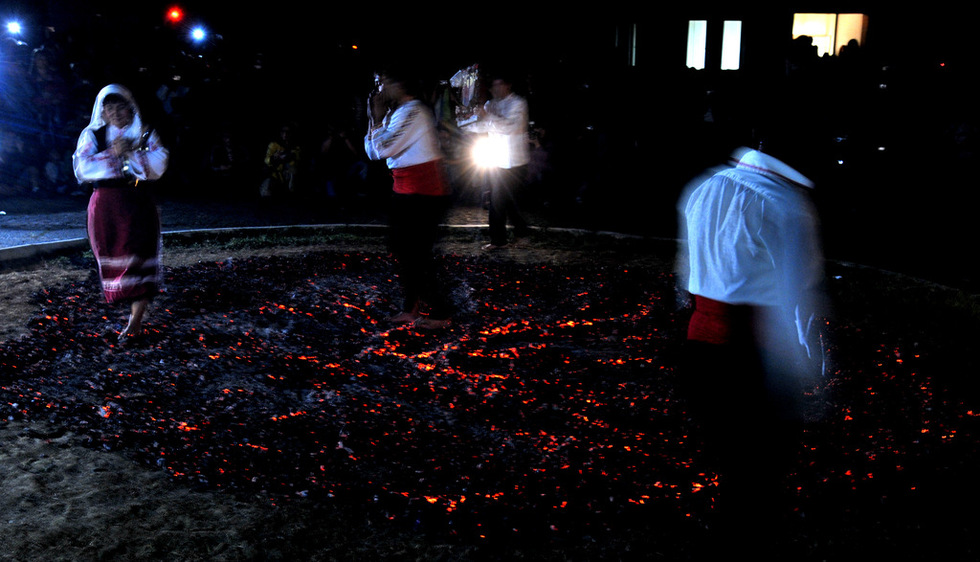
At this stage, they are already stomping around in full ecstasy. They dance, say prayers, and get a wild look in their eyes, their bodies jerking as they raise the icons toward the sky and move across the fire in a ritual trance. At the same time, they exhibit the debated phenomenon known in Greek as akaïa (incombustibility) – the ability not to get burned.
Finally, they leave the fire filled with joy and relief – unharmed and, with very few exceptions, without burns. Drenched in sweat, pale, and exhausted, as if after a major physical ordeal, they now calm down and reverently kiss the icons before handing them over to the group leader.
Akaia – the phenomenon of incombustibility
Much has been written and said about firewalking, particularly about the phenomenon of akaïa (incombustibility). Relevant references can already be found in the writings of classical antiquity. Today, entire studies have been published presenting various viewpoints, often colored by the researchers’ own ideological convictions. The fact remains, however, that even today, science struggles to fully provide a comprehensive explanation for the phenomenon.
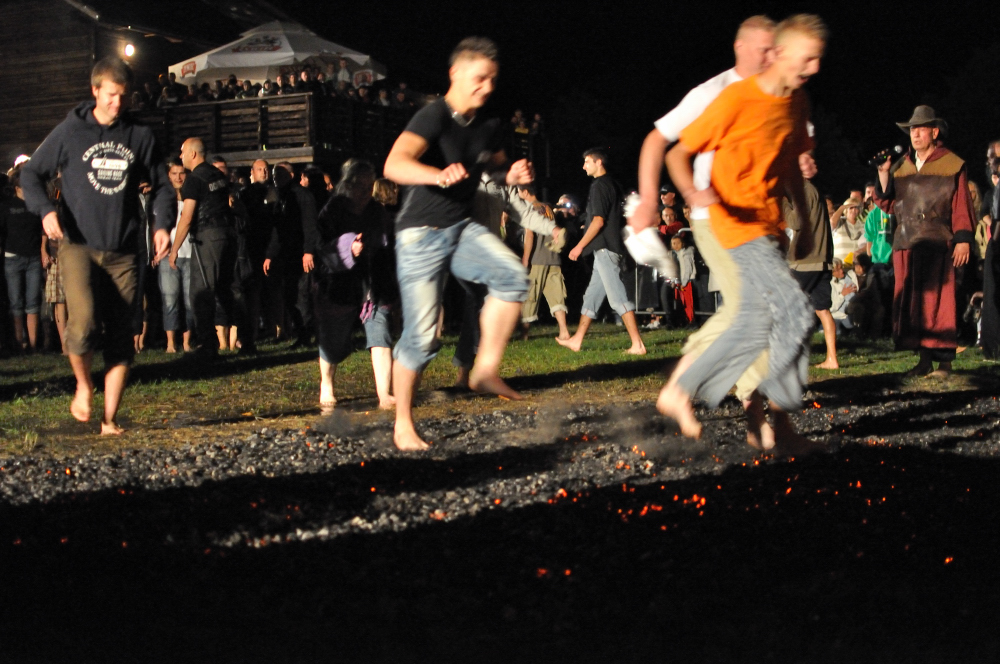
It is believed that the explanation for the incombustibility partly lies in the firewalkers’ fast footwork, meaning that they move rapidly over the coals from one foot to the other. Another explanation is that charcoal is a poor conductor of heat. This means that the skin does not have time to suffer burns, provided that the firewalking is performed with the correct speed and technique.
However, everyone agrees that a prolonged psychological preparation is necessary, if only to gather the courage to step onto the glowing coals in the first place, which, according to measurements, reach temperatures of several hundred degrees.
In recent years, “schools” for firewalking have actually been started in both the US and Western Europe, and seminars are organized around this ancient custom.
In their promotional brochures, modern instructors claim that these ancient techniques contain nothing supernatural or magical. Instead, they argue that the methods are accessible to anyone wishing to boost their self-confidence, courage, and mental strength – even though these courses and seminars often come at a noticeable financial cost to the participant.
When it comes to the phenomenon of incombustibility, however, the classic adage will always hold: those who don’t know any better shouldn’t play with fire.
It is worth reminding ourselves that firewalking is a global phenomenon found in widely differing cultures worldwide, from Siberia and Tibet to the Fiji Islands and among the indigenous peoples of North America.
Myth and tradition
Following the 1923 population exchange between Greece and Turkey, the Greeks of Eastern Rumelia were forced to leave their homes and settle in northern Greece. With them, they carried not only their few belongings but also their sacred icons – the so-called “chares” and “pappoudes” – which in most cases depicted Saint Helen and Saint Constantine. Along with them, the Anastenaria tradition also crossed the border.
According to myth, the tradition originated during the persecutions of the Greeks in Eastern Rumelia, when Ottoman troops set fire to their churches. The story goes that the inhabitants gathered weeping outside the Church of Saint Constantine and Saint Helen, at which point they were granted divine power. The saints are said to have appeared to the villagers, giving the faithful the strength to walk straight through the fire to rescue the icons.
Today, folklorists agree that the Anastenaria tradition has its roots in the villages of Eastern Rumelia. The first official documentation of the custom was made in 1872 by Professor Anastasios Hourmouziadis. His speech at the Greek Orthodox Academy of Constantinople was titled: “On the Anastenaria and other peculiar and superstitious traditions“.
Metrorama Athens, Tuesday 22 May 2001, by Georgios A. Georgiou
A quarter of a century later
Twenty-five years have passed since this article was published in Metrorama Athens. In the meantime, the world has changed, but the Anastenaria still lives on in northern Greece – somewhere between faith, ecstasy, folklore, and living history.
Much about firewalking has, over time, been analyzed and partly explained by science. At the same time, a strange question mark remains surrounding the ritual for anyone who has truly witnessed it at close quarters. Many participants do not seem to just quickly pass over the coals, but instead remain on them for a long time, dancing in the middle of the fire for several minutes.
I still remember the feeling myself from the village of Langadas, when the drums thundered through the night, and people danced barefoot across the glowing bed of coals. Even today, it is difficult to entirely shake the impression of having witnessed something that, at least for a moment, seemed to defy both reason and the laws of nature.
📥 Download the original article from: Metrorama Athens (PDF)
📖 On our blog, you will find several related articles about Greek folklife and tradition.