
The Hellas Herald – part of Greek Expedition
- How did the outside world perceive Greece in the 19th century, as the young nation began to take shape?
- What role did travel writers and artists play in shaping the image of this new Greece?
- What do the news columns tell us about 19th-century Greece, a time when it was viewed by many as an almost exotic destination?
In our new series, Hellas Herald, we are delving into travelogues, art, poetry, and contemporary newspaper archives, we are piecing together a mosaic of voices to approach the questions surrounding Greece in the 19th century.
We begin our search through this archival treasure trove with the story of the fearless artist Elisabeth Jerichau-Baumann. A long-forgotten article in Göteborgs-Posten, a Swedish newspaper, from October 30, 1880, left us speechless before the adventures of this fascinating Polish-Danish artist.
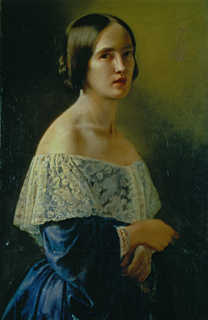

Elisabeth Jerichau-Baumann (1819–1881)
Elisabeth Jerichau-Baumann was a Danish-Polish artist who painted with a burning creative fervor and lived driven by an appetite for adventure that could not be contained by the narrow female ideals of her time.
With immense energy, she took 19th-century Europe by storm. After giving birth to nine children between 1847 and 1861, she embarked on her great international travels. Today, we will follow her intense journeys through the starkly contrasting landscapes of the Orient and Southern Europe. She spent a great deal of time in Greece during the 19th century.
Reader’s tip: At the end of this article, we take a look at the 19th-century advertising market – hilariously entertaining! 👇
The path to European artistic life
As a young artist, Elisabeth Jerichau-Baumann tried to adapt to a Danish cultural climate characterized by strong national romantic currents. She became known as one of the most typical representatives of the style in Danish art. Since the art academies of the time did not allow female students, she was mostly self-taught through extensive independent studies.
Later, she moved to Rome, where she quickly became part of the German artist colony. It was also there that she met the Danish sculptor Jens Adolf Jerichau, whom she married. Her husband’s own erotically charged statues gave her the courage to ignore the local narrow-mindedness and pursue her own sensual style of painting, despite the great social risks for a woman in the 19th century.
Although she kept Rome as her fixed base, she was constantly on the move. Her own books, Ungdomserindringer (1874) and Brogede Rejsebilleder (1881), provide vivid, albeit strongly romanticized, depictions of the colorful and international artistic life of that time.
From the world of fairy tales to royal courts
In these circles, H.C. Andersen also moved, who had traveled in Greece in the 19th century as well.
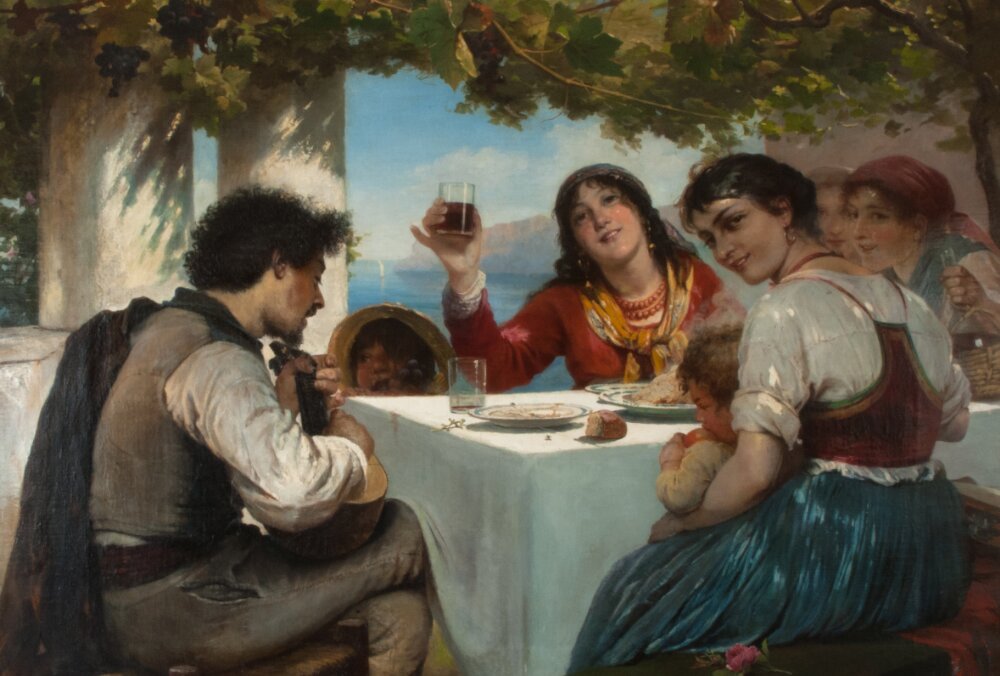
Elisabeth immortalized the storyteller in a painting where he reads to her own children. But her connection to Andersen and his works did not stop there. She also created a series of acclaimed paintings with mermaid motifs and gifted one of these works to him.
Her ability to capture life and character quickly made her sought after among the absolute elite of Europe. Before Elisabeth turned her gaze eastward, she had already won great recognition and secured prestigious commissions from royals across the entire continent.
Travel in Greece in the 19th century
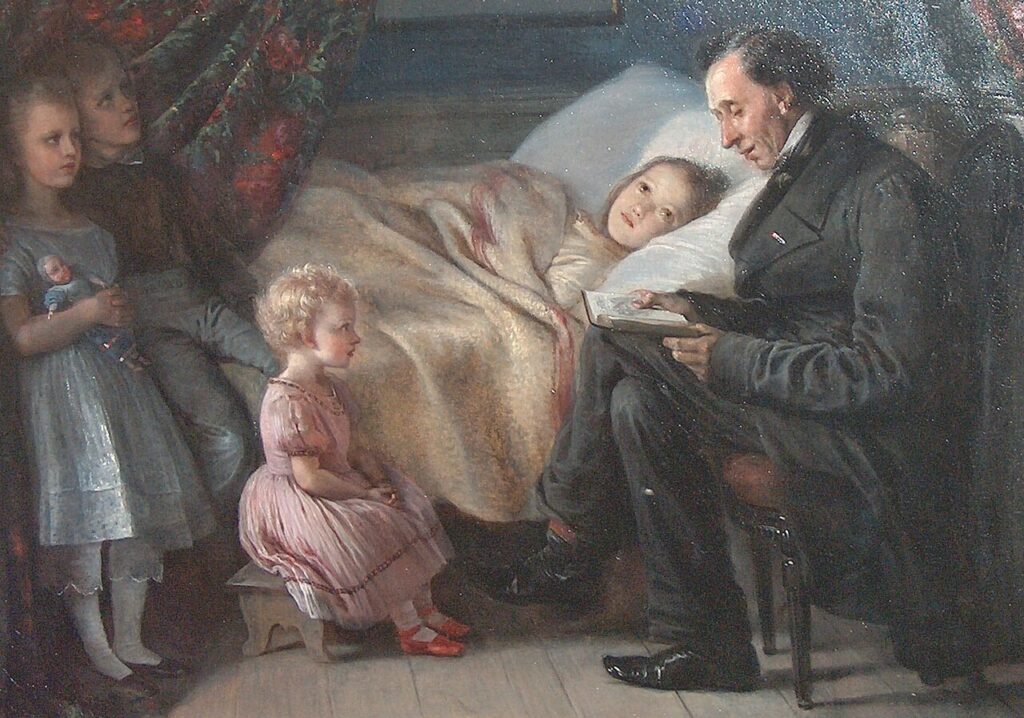
She soon felt cramped by Danish cultural life. Her temperament and great ambitions required more space than the North could offer. She packed her brushes and headed east, towards environments completely different from the usual European artistic hubs. Ahead of her waited a colorful and perilous existence that stretched from the royal court in Athens and encounters with outlaws in the mountains of Attica to the closed doors of the sultan’s harem in Constantinople.
The Royal Court in Athens
In Athens, she quickly charmed the Greek royal couple, George I and Queen Olga. That the young king was a Danish prince by birth became Elisabeth’s perfect ticket to the palace.
Soon she was sitting in the royal salons, portraying the court in a city that was transforming into a new, modern metropolis. With her unfailing charm and courage, Elisabeth stepped straight into the corridors of power without hesitation. She not only managed to win the royal family’s trust, but also became a frequent chronicler of the rest of Athenian society, where the ancient heritage met the new, colorful elite of the 19th century.
The outlaws in the mountains of Attica
Traveling in Greece in the 19th century was not risk-free, and the mountains of Attica hid dangers that required a completely different kind of courage than the quiet salons of Athens. Her choice to paint out in the open was at this time very unusual in Greece, especially for a woman, because the countryside was constantly threatened by lawless bands of outlaws. These bands of outlaws were a genuine social plague that paralyzed the countryside, but they were also deeply intertwined with the local politics of the time.
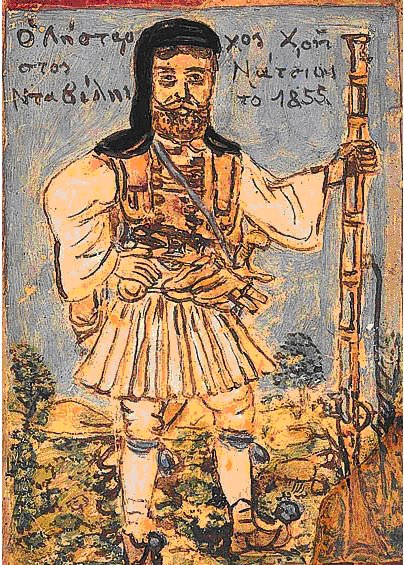
For the still young nation, the bandits were merely criminals who threatened the security of the state. But among the people, they were often seen as heirs to the old freedom fighters of the revolution, the klephts and armatoles, who protected the local population against the exercise of state power. Elisabeth Jerichau-Baumann refused to let herself be stopped by the dangers in this charged environment.
She bravely ventured into the mountains to immortalize “native Greek bandits and outlaws.” Although these specific paintings have been lost to the shadows of history, newspaper articles from the 1880s testify to a courage that lacked precedent in the European salons of the time.
In Göteborgs-Posten, her dramatic and contrast-filled time in 19th-century Greece is described as follows:
📜 She spent some time at the court of the King of Greece, occupied mostly with painting portraits, portraits of kings, queens, and princes, but also of native Greek bandits and outlaws.
The secrets of the Ottoman harems
Elisabeth did not stay long with the Greek royal couple. She sought to travel further east to Constantinople, where she achieved the rare feat of gaining access, as a Western woman, to the city’s otherwise completely closed Ottoman harems.
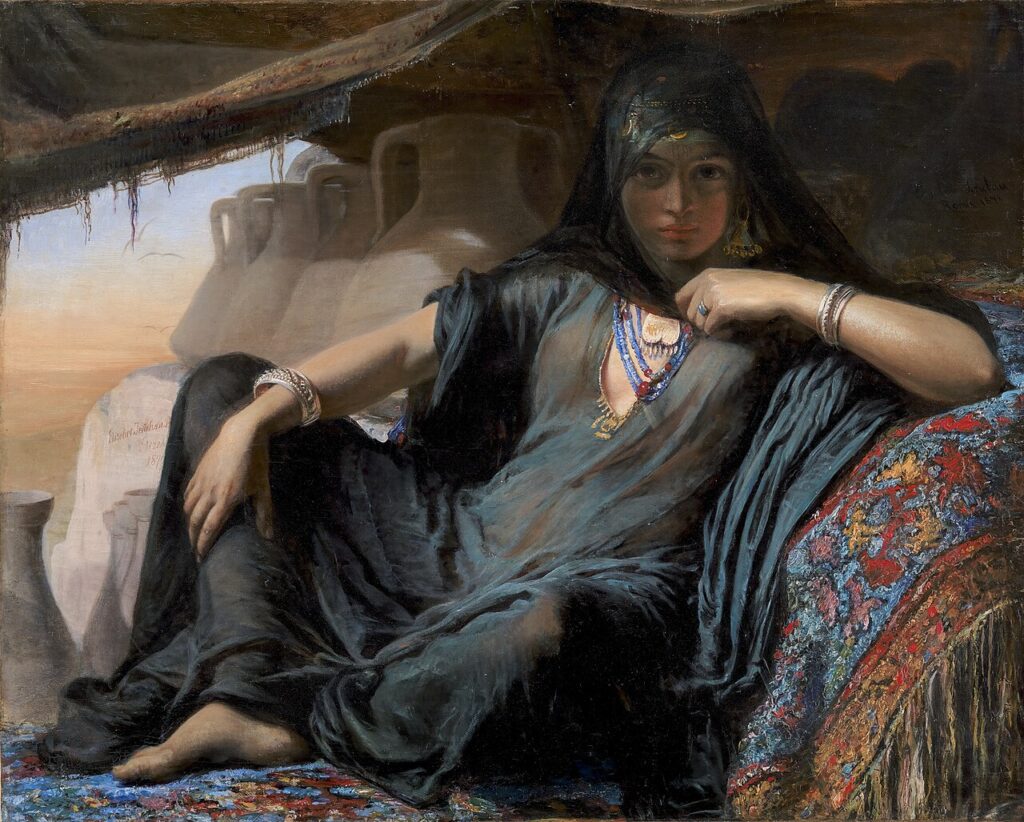
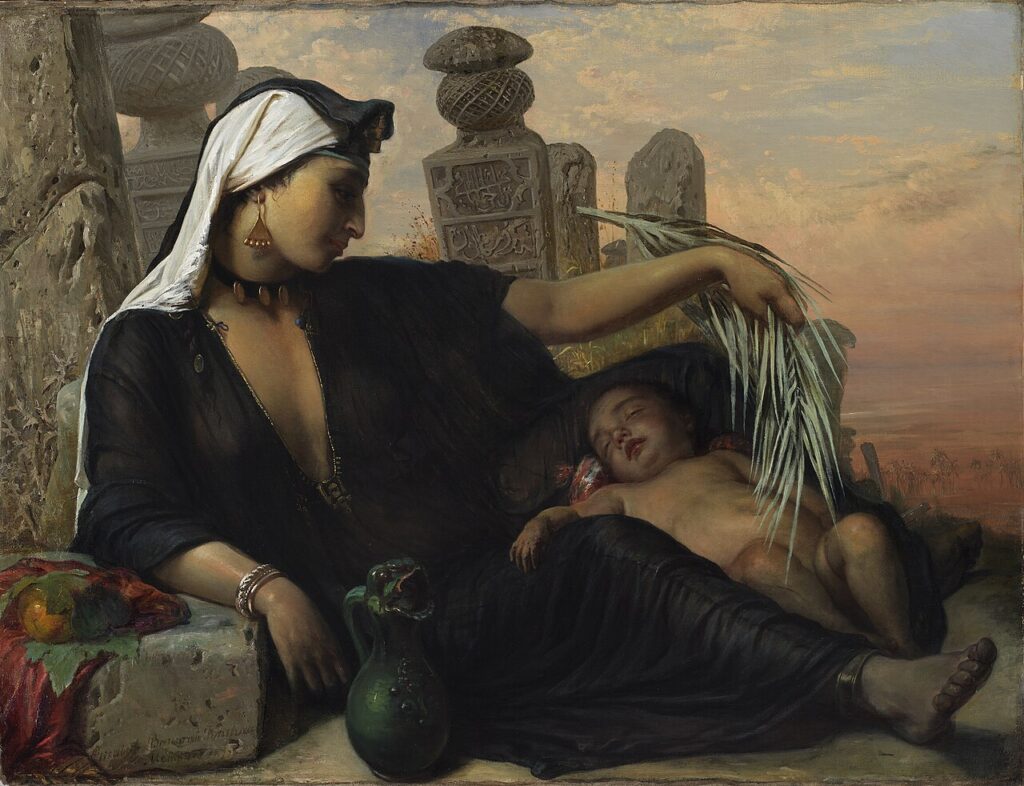
The journey then continued even further south, to Egypt, where, on the outskirts of Cairo, she found new motifs that continued to challenge the European audience’s view of the women of the Orient.
Her paintings from there differed radically from the exotic fantasies of contemporary male artists. Because she had actually spent time close to the women, she did not portray them as anonymous objects, but with a rare psychological depth, dignity, and a vibrant light that captivated the art world.
The echoes of the era in the printing presses
Her life and career continued to fascinate long after she had left the Mediterranean, which is clearly visible in the contemporary press. During the 1880s, her achievements were written about with great admiration in Swedish media. When Elisabeth Jerichau-Baumann exhibited her works in Gothenburg in the autumn of 1880, it attracted great attention.
In Göteborgs-Posten, the exhibition was described as an event where the art was studied with “lively interest and great pleasure.” The writer reflected on her artistic development and the unique experiences she had gathered during her travels:
📜 Afterwards, she stayed in Constantinople and gained access to Mustapha Fazil Pasha’s harem, where she portrayed his beautiful daughter on behalf of the Princess of Wales. In the collection she has now exhibited, there are also portraits of several beautiful harem ladies, but with fictitious names—a delicacy toward the amiable ‘hanums’ (princesses), which was probably less dictated by their own desire than by the moral laws of Muhammad…
Through these words from 1880, the image of an artist emerges who not only mastered her choice of color and lighting but also navigated a complex world with an unusual sensitivity for cultural conventions.
A life in the service of art
Elisabeth Jerichau-Baumann was a force of nature who proved that a woman with a paintbrush could be just as quick-witted, powerful, and unstoppable as her most celebrated male colleagues. At her passing, her life’s work and her rebellious spirit were celebrated. She is still considered by many to be a true pioneer.
Her contemporaries remembered her not only for her canvases, but for the vitality she radiated until the very end. In one of the obituaries, it was described how she, at a large banquet in Gothenburg’s finest reception hall, had captivated her audience:
📜 She captivated everyone with the fiery and captivating immediacy with which she took the floor in a gathering of five hundred people… it would have taken more to break her immense energy, which was based on the most sincere conviction that a true artistic talent resided within her.
It is a moving description of a woman who, until her very last breath, lived with “her usual liveliness,” her warm devotion to art, and her flashing brilliance.
The analog noise of the 1880s
Before we put a period to this first issue of Hellas Herald, we linger for a moment over the newspapers of that time, consisting of long vertical columns. The contrasts in the media climate of the 19th century are striking; when we study old newspapers, such as Sydsvenska Dagbladet Snällposten, we see how news reporting, cultural advertisements, and commercials for daily necessities jostled for space on the same surface.
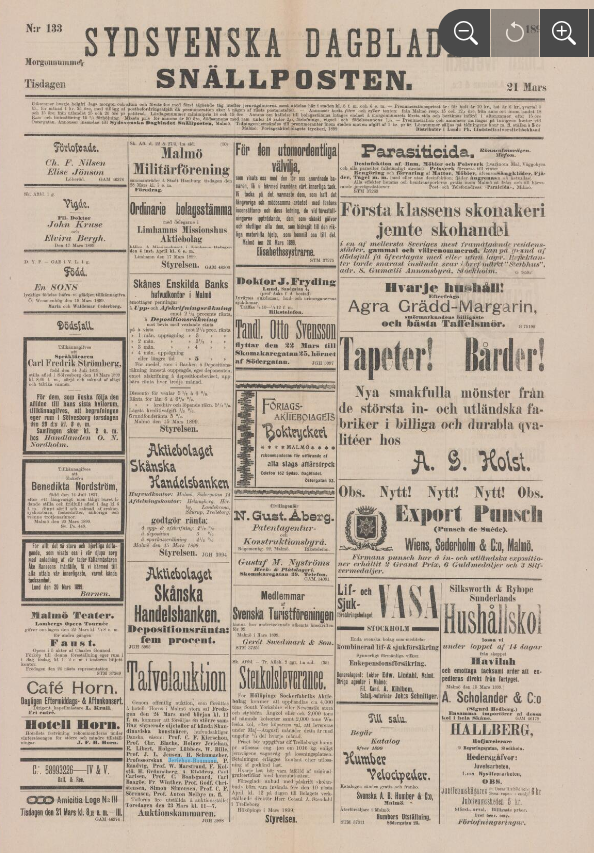
It is a reminder that the newspaper reader of the past was met by an entirely different kind of “analog noise” than today’s digital feeds. Right next to notices about art auctions and cultural events were advertisements for everything from military associations to the home remedy “Parasiticida.”
Reading a page from that time is like stepping into a world where the sublime – such as the art of Elisabeth Jerichau-Baumann – constantly had to share the stage with the more grounded, and for us sometimes purely absurd, concerns of everyday life.
Related article
The Greek islands between the 16th and 20th centuries, part 1