
Greek mythology is most often associated with the gods of Olympus, heroic warriors, and the great stories that survived through antiquity. But behind the best-known myths lies another landscape – one filled with strange beings, local legends, forgotten symbols, and fragments of myths that have lingered in the shadows for centuries. That is where this new series will take us.
Greek mythology is not, and has never been, a single cohesive narrative. It was shaped and reshaped over millennia by poets, sailors, priests, villagers, and wandering storytellers. While some figures became famous throughout the ancient world, others faded over time, surviving only in scattered references, regional folklore, or half-forgotten traditions from marshes, mountain ranges, and remote sanctuaries.
In this new series, we explore some of the lesser-known layers of Greek mythology – the strange, the overlooked, and the elusive, not through heavy academic analysis, but through stories, images, and motifs that still carry a peculiar allure thousands of years later.
In this first article, we meet, among others:
- Silenus – the old, constantly drunken companion of Dionysos, somewhat comical but with a wisdom that feels almost unsettling.
- Gitauros (Γίταυρος) – a shadowy being from Greek folklore, associated with misty marshes and bull-like cries in the night.
- The shield of Achilles – forged by Hephaestus himself, not just as a weapon but as an entire world in metal: oceans, cities, stars, harvests, war, and the cosmos itself.
And this is just the beginning. Behind these first figures, many more strange characters, symbols, and stories are waiting to emerge once again from the shadows of mythology.
Silenus – Dionysos’s enigmatic companion
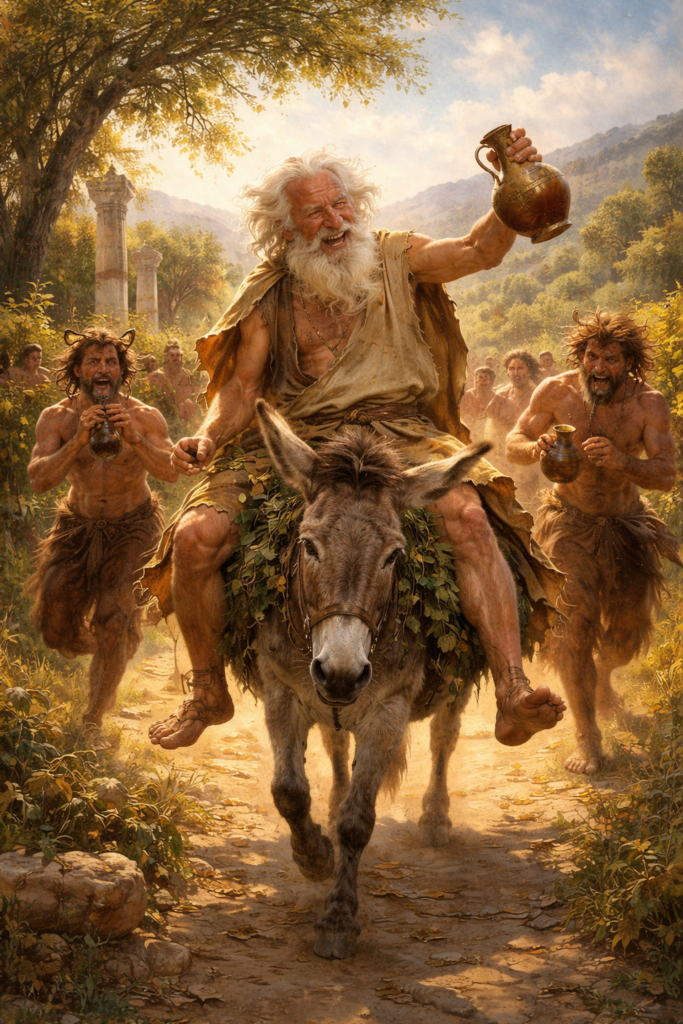
Among the wild retinue of Dionysos moved Silenus, a figure long associated with ecstasy, wine, and a dark view of human existence. But who was Silenus? A constantly drunken old man wobbling along on a donkey, or one of Greek mythology’s misunderstood figures?
The wise straggler in the shadow of Dionysos
When imagining the procession of Dionysos, one often pictures ecstatic maenads and lithe satyrs dancing through the forest. But at the very back of the clamorous retinue, wobbling on the back of a tired donkey because his legs can no longer carry him, we find Silenus. He is one of Greek mythology’s most paradoxical figures: a constantly drunken, stout old man with a snub nose, whose exterior conceals a wisdom deeper than that of most gods.
Silenus was Dionysos’s teacher and foster father, and he belonged to an older generation of nature spirits, the satyrs. While the ordinary satyrs were young and wild, Silenus represented the mature, almost overripe, force of nature. In art, he is often depicted with a leather wine flask slung over his shoulder and a wreath of ivy around his bald head. He is a figure who lives on the margins; he is never the center of the party, but rather the strange shadow that lingers when the wine begins to run out.
There is, however, something enigmatic and mysterious beneath this comical and grotesque exterior. Silenus possesses the gift of prophecy – an ability he only shares if caught asleep or forced into it through trickery.
The most famous legend tells of how King Midas poisoned a spring with wine to lure Silenus into a trap. Once the drunken old man was captured, the king forced him to reveal his deepest insight. Silenus’s response became one of antiquity’s most famous and darkest truths:
“The very best thing for a human being is not to be born at all. The next best thing is to die as soon as possible.”
This is the core of Silenus. In Greek mythology, he represents not just happy, superficial intoxication, but the Dionysian insight into the fleeting nature and pain of life. His wisdom is not the cool logic found among the Olympian gods, but an earthy, instinctive understanding of the chaos of the universe. In ancient Greece, he was a reminder that truth is often found where we least expect it – in intoxication, in the shadows, and in the ones the world uses to laugh at.
Silenus remains one of mythology’s most fascinating figures: a divine fool straggling behind in history, bearing a truth that is just as heavy as he himself is drunk.
Gitauros – the mist-shrouded being of Thessaly
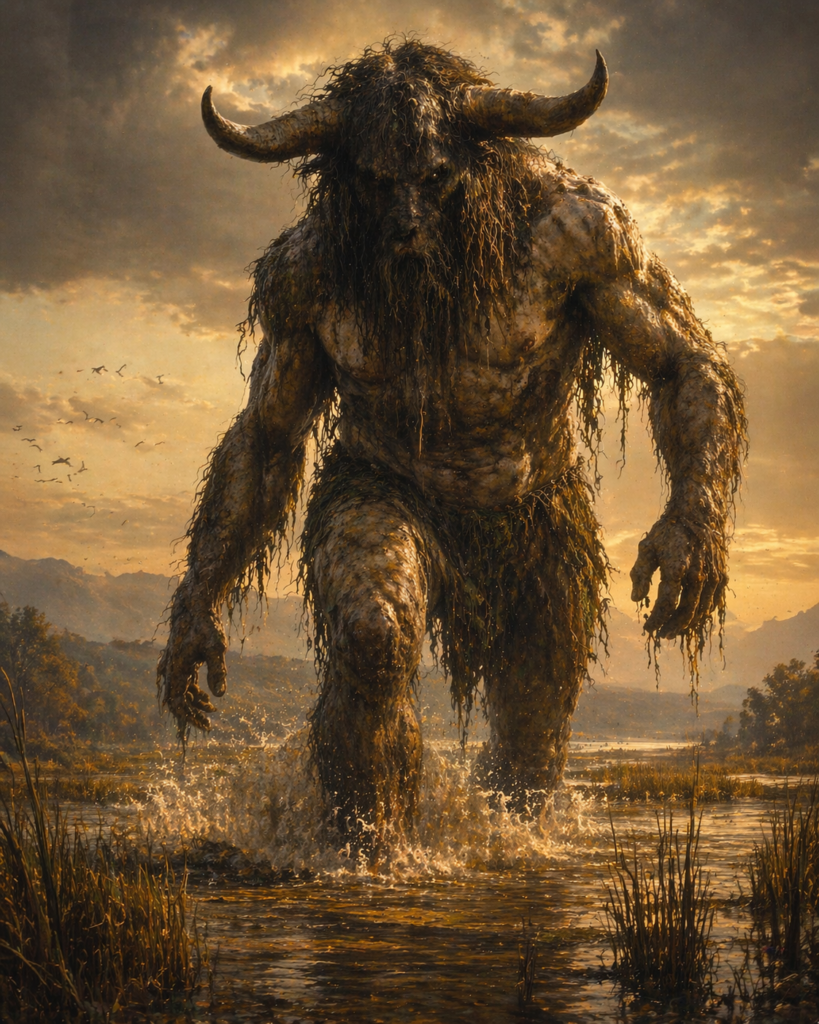
Far from the gleaming marble halls of Olympus, many older and stranger creatures continued to live on in Greek folklore. In the misty marshes and river landscapes of Thessaly, Gitauros (Γήταυρος) was said to roam, his bull-like cries echoing through the night. Who was this Gitauros, and where did he come from?
The mysterious sound of the nocturnal wetlands
Where the great epics fall silent, folklore takes over. Gitauros is not a figure found in classical dramas or on the finest vases; he belongs to oral storytelling, to the warnings whispered among villagers in ancient Thessaly. The name suggests a creature with traits of both human and bull, but unlike the Minotaur in his labyrinth, Gitauros is bound to water and mist.
He is often described as a shadowy being that frequents the deep marshes and the reedy banks of rivers. He is a creature that is rarely seen but often heard. The characteristic “lowing” echoing over the water during the darkest nights gave rise to stories of a lonely wanderer doomed to haunt the borderlands between land and sea. In folklore, he became a symbol of the unknown and dangerous lurking in nature’s hidden recesses – the places where humans are vulnerable and disoriented.
Few clear descriptions of Gitauros have been preserved. Instead, the figure appears fragmentarily in older encyclopedias, folk traditions, and regional stories, particularly linked to Thessaly – an area that even during antiquity was surrounded by rumors of magic, witchcraft, and strange rituals.
The strange thing about Gitauros is how this ancient, primal fear of nature’s own forces has managed to survive in the collective memory, proving to be more resilient than the classical temples of ancient Greece.
Hearing Gitauros was an omen that you had come too close to a dangerous place, or that the mist was about to swallow the path. His cry was not just a sound, but a reminder that we are not alone in the darkness, and that some beings prefer to remain precisely sounds and shadows.
Through Gitauros, we see another side of Greek mythology: the regional, down-to-earth horror that is less about gods and more about the actual environment people lived in. He is the voice of the marsh, a primal force that cannot be tamed or explained away by heroic tales, but instead continues to wander through the mist as long as there are nights quiet enough to carry his cry.
The shield of Achilles
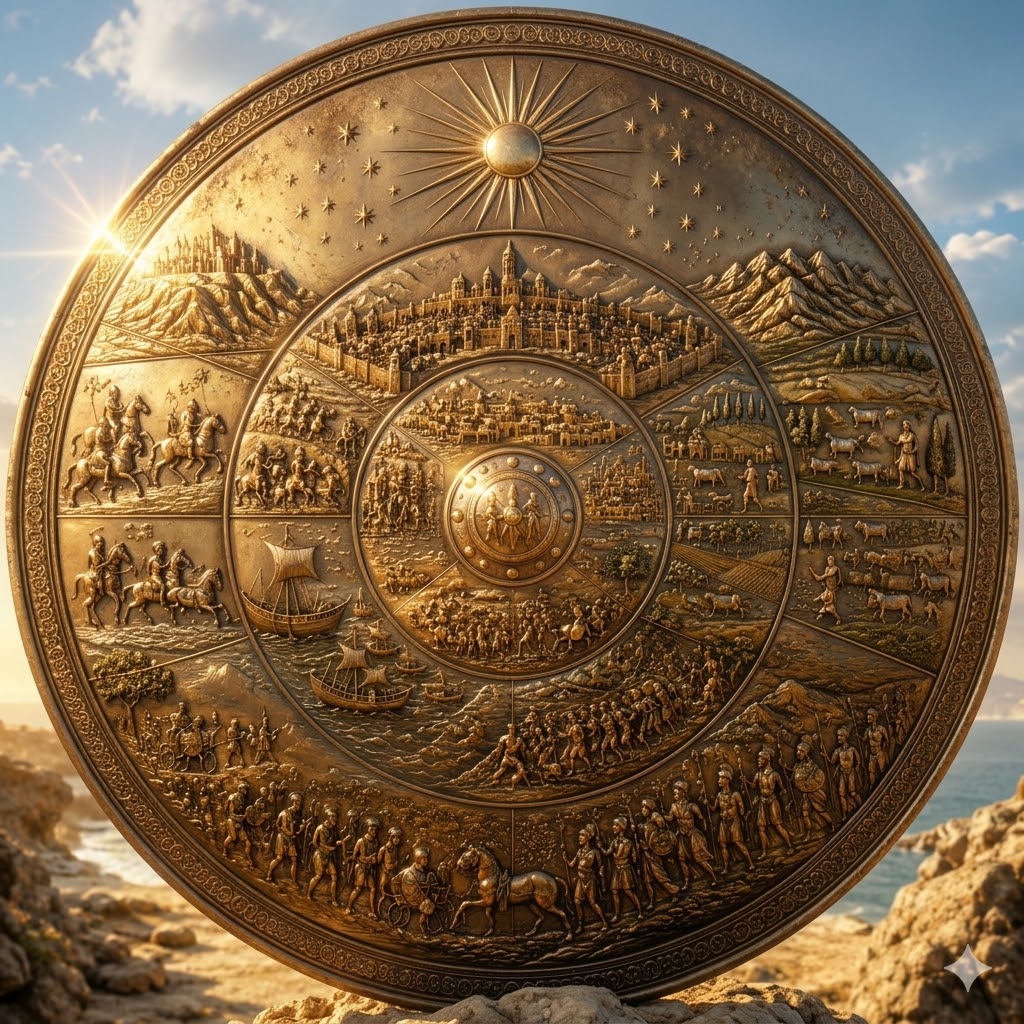
When Hephaestus forged Achilles’s new shield, he did not just create a weapon for war. But what did the shield of Achilles actually look like? In the Iliad, it is described as an entire world in shimmering metal – filled with cities, oceans, starry skies, harvests, processions, armies, and the eternal rhythm of human life.
A microcosm in bronze and gold
In the eighteenth book of the Iliad, the roar of war pauses for a moment. Achilles has lost his armor, and his mother Thetis seeks out Hephaestus, the god of metallurgy, to ask for a new set. What emerges from the god’s forge is not merely a shield against arrows and swords, but one of the most magnificent motifs in literary history: a microcosmic mirror of the entire ancient world. Hephaestus was regarded as the master smith of the gods, but in the story of Achilles’s shield, he appears almost as something more: a creator of worlds.
The description of the shield occupies a surprisingly large part of the Iliad. In the middle of the narrative of Troy’s bloody war, Homer pauses the action to let the reader contemplate this strange object, where layer after layer of scenes emerge from the metal.
At the center of the shield, Hephaestus forged the earth, the sky, and the sea, along with the sun, the moon, and the constellations that guide sailors: the Pleiades, the Hyades, and Orion. Around this center, scenes from ancient life unfold in concentric circles.
We see two cities. In one, wedding celebrations are underway with torchlit processions and singing to flutes and lyres, while men gather in the marketplace to resolve a legal dispute. The other city is surrounded by two armies; here, ambushes by a river are depicted, along with battles with spears and figures personifying hatred and panic in the turmoil of war.
Then follow scenes from the countryside. Plowmen drive their oxen across fertile fields, harvesters work with their sickles, and youths carry baskets of dark grapes from a vineyard of gold. There are also images of grazing cattle being attacked by lions, as well as a large dancing floor where young men and women dance in a ring with their hands around each other’s wrists.
All of this is framed by the outermost edge, where the river Oceanus flows – the great waterway that the people of antiquity believed encircled the entire universe.
The shield of Achilles has fascinated everyone from archaeologists to poets through the centuries. Countless attempts have been made to reconstruct it, but its true nature remains literary. It is a reminder that mythology is not just about monsters and heroes, but also about the art of capturing the entire universe on a round surface of hammered metal.
At the fringes of Greek mythology
Behind the most famous gods and heroic tales of Olympus lies another mythological landscape – more fragmented, elusive, and often stranger than the stories that have remained in textbooks and pop culture. There we find figures like Silenus, whose laughter conceals one of antiquity’s darkest insights into life, mist-shrouded beings like Gitauros, and objects like the shield of Achilles, where the entire universe seems to be contained in metal and fire.
It is also here that Greek mythology perhaps feels most alive. Not as a closed system of finished narratives, but as fragments from different times and places – sometimes grand, sometimes unsettling, sometimes almost dreamlike.
In upcoming parts of the series, we will continue to move through these lesser-known layers of mythology. More strange beings, forgotten symbols, and overlooked stories still wait in the margins, far beyond the most well-trodden paths through ancient Greece.
Related articles
Greek gods – and mythology, part 1
The ancient Olympic Games – from mythology to history