
Heracles is one of the best-known figures in Greek mythology. But in the ancient sources, the name does not always refer to the same person. Another Heracles also appears there, connected with the mysterious Dactyls of Mount Ida and with a lesser-known tradition concerning the origins of the Olympic Games.
This is a good example of how Greek mythology can shift between different sources and traditions. The same figure may have different parents, names, appearances and exploits depending on place, period and author. Sometimes different stories also merge and overlap.
In Part 3 of our series on Greek mythology’s strange beings and forgotten legends, we follow some of these side paths further: from the Idaean Dactyls to the three-bodied giant Geryon, and on to the multi-headed dogs Orthrus and Cerberus.
The Idaean Dactyls
The Dactyls were male divine or semi-divine beings associated with the Great Mother goddess, especially in the forms of Rhea and Cybele. They were also linked with metalworking, fire and magic. Beyond that, however, the ancient sources describe the Dactyls in very different ways. Their number varies, as do their names and places of origin, and in some traditions they almost merge with other mythological groups.
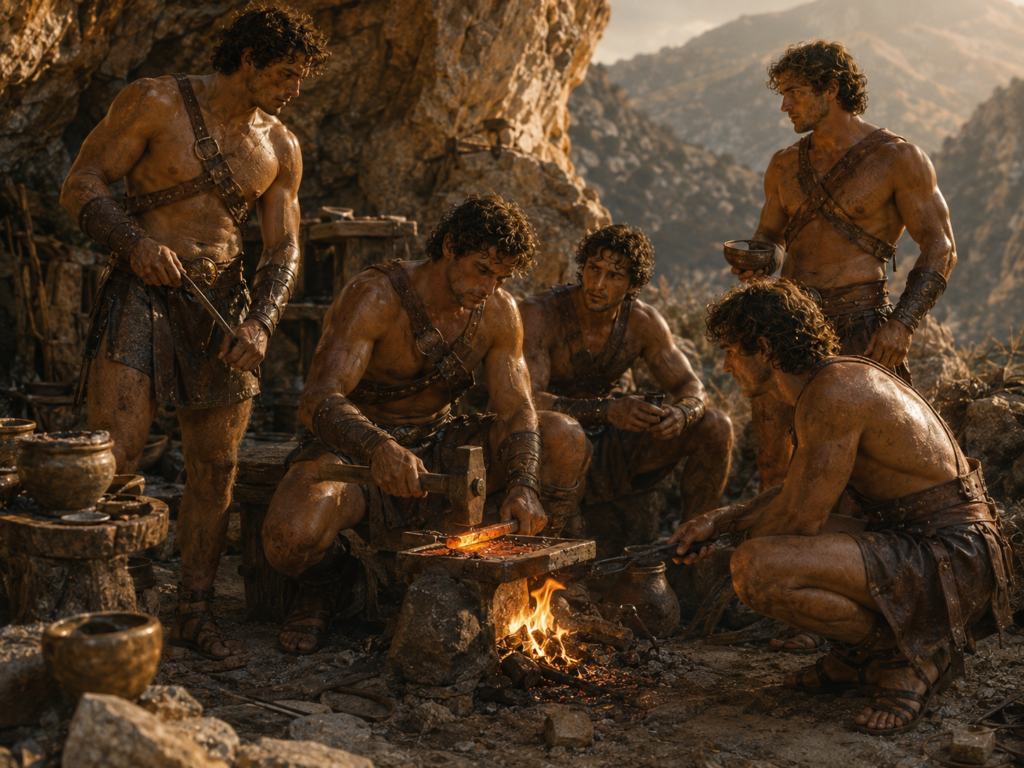
Mount Ida does not always refer to the same place either. One Mount Ida lies on Crete, while another stood in ancient Phrygia in Asia Minor. There were also other local traditions concerning the Dactyls, including on Rhodes.
Another widespread tradition says that the Dactyls came into being when Rhea was about to give birth to Zeus. She was trying to save the newborn Zeus from his father Cronus, who devoured his own children to prevent any of them from one day overthrowing him. When Rhea pressed her fingers into the earth during the birth, the Dactyls were born – and the Greek word daktyloi means “fingers”.
The Greek geographer Pausanias, writing in the 2nd century AD, records an Elean tradition in which the Dactyls are five in number and individually named. Heracles corresponds to the thumb, Paeonius to the forefinger, Epimedes to the middle finger, Iasius to the ring finger, and Idaios – also called Acesides – to the little finger.
This Heracles, the eldest of the brothers, was said to have organised a footrace between them and crowned the winner with a wreath of wild olive. According to the same tradition, this was the origin of the later Olympic Games. The Dactyl Heracles was also said to have brought the wild olive itself from the mythical land of the Hyperboreans, far to the north.
The traditions surrounding the different figures named Heracles later began to overlap, and exploits originally attributed to older figures could eventually be transferred to the more famous hero Heracles.
The Dactyls are also often associated or confused with the Curetes, Corybantes and Cabeiri – other groups of mythical beings connected, among other things, with the Mother Goddess, ritual and metalworking.
In our next story, about the fearsome giant Geryon, we will encounter the more famous Heracles: the son of Zeus and Alcmene, and the hero who performed the Twelve Labours.
Geryon – the Fearsome Giant at the Western Edge of the World
In his tenth labour, Heracles was sent to steal the cattle of the fearsome giant Geryon. This was no ordinary herd, but a magnificent collection of red cattle grazing on the island of Erytheia, at the western edge of the world as imagined in Greek mythology. Heracles’ voyage across the sea later became a popular subject among ancient vase painters.
What the giant Geryon himself looked like depends, as so often, on which source you read.
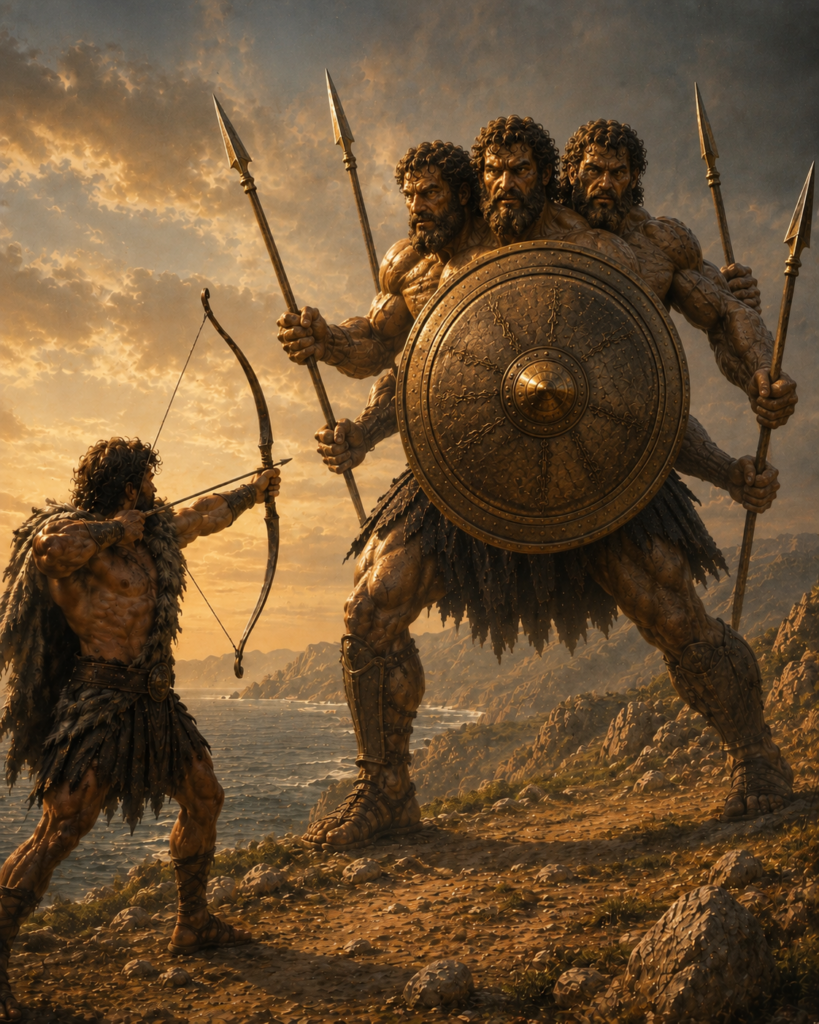
One body with three heads? Three bodies with one head? Six arms and six legs? Wings? All of these versions appear. What they have in common is that Geryon is portrayed as a huge and terrifying figure, often armed like a warrior – and that the number three somehow seems to be part of his nature.
His family tree is just as strange as his appearance. According to myth, Geryon’s father Chrysaor was born when the hero Perseus cut off the head of Medusa, the monster whose gaze could turn people to stone. At the same moment, the winged horse Pegasus was also born. The giant Geryon therefore forms an important link in one of the best-known stories of Greek mythology.
Geryon’s cattle were guarded by the herdsman Eurytion and the two-headed dog Orthrus. Heracles killed Orthrus with a single powerful blow from his olive-wood club and then killed Eurytion as well. When Geryon heard the commotion, he rushed into action, according to one version, carrying three shields, three spears and wearing three helmets. Heracles met him with an arrow dipped in the poisonous blood of the Lernaean Hydra and brought the giant down.
Palaephatus, a Greek mythographer who often sought rational explanations behind ancient myths, suggested that the idea of Geryon having several heads may have arisen from a misunderstanding connected with the place the giant came from. It was called Tricarenia, a name that can be interpreted as “Three Heights” or “Three Heads”.
Geryon continued to appear in literature long after antiquity. More than a thousand years later, he turns up again in Dante’s Inferno – this time in a new and even stranger form.
Orthrus – the Dog in the Shadow of His Famous Brother
Orthrus is much less famous than his brother Cerberus, the dog who guarded the entrance to the realm of the dead. Both were children of Typhon and Echidna, two of the great primordial monsters of Greek mythology and the parents of a long line of other terrifying creatures.
Orthrus’ task was to guard Geryon’s precious red cattle on the island of Erytheia.
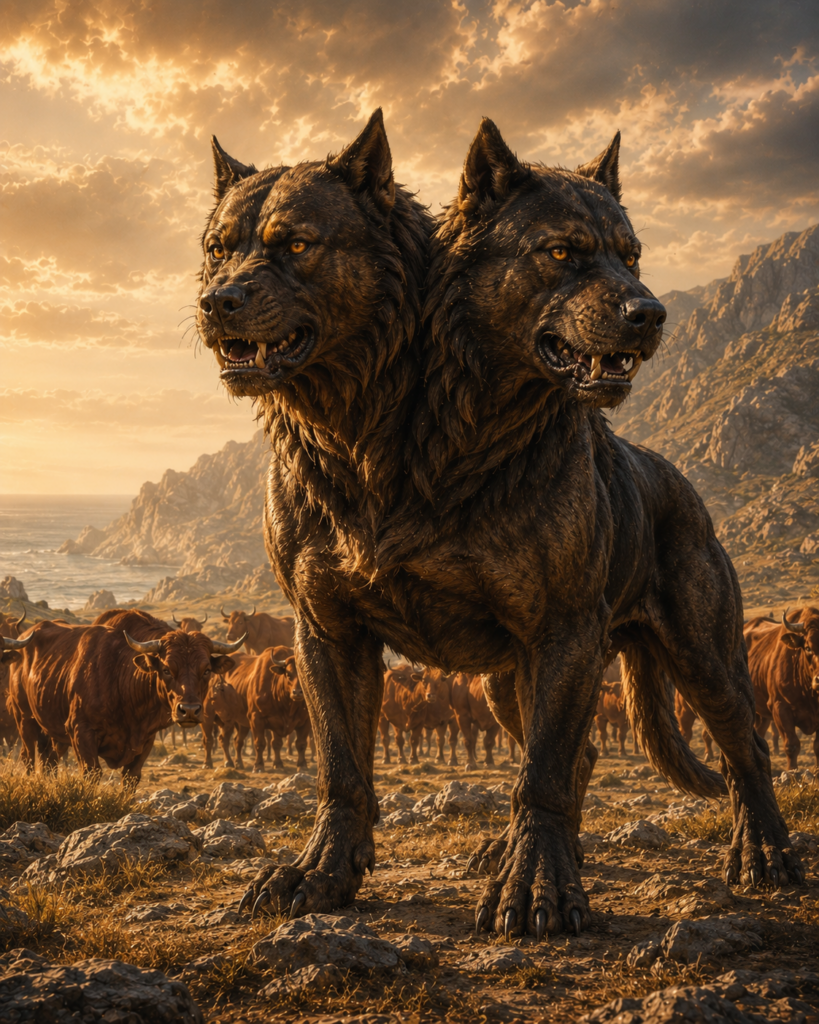
He is most often described as two-headed, but here too the sources vary. In some he has only one head, in others three. Depictions of Orthrus are rare and are almost always connected with Heracles’ theft of Geryon’s cattle.
Accounts of his death also differ. In the version we have just followed, Heracles kills Orthrus with his club. In some ancient depictions, however, Orthrus is shown pierced by arrows.
His brother Cerberus is an even clearer example of how a mythological figure’s appearance could change over time. In the earliest literary sources, he could have fifty – or even a hundred – heads. Only later did the three-headed version become dominant and the one best known today.
Orthrus’ family tree also has its surprises. A passage in the poet Hesiod can be interpreted as making Orthrus and the Chimera the parents of both the Sphinx and the Nemean Lion, two other feared creatures of Greek mythology. Here too, however, the sources are ambiguous and different traditions offer varying versions.
From Orthrus to the Underworld
Cerberus belongs above all to another story. Not long after the encounter with Geryon, Heracles is sent down into Hades, the realm of the dead, where the many-headed watchdog plays a much larger role.
In this part, we have seen how closely the different strands of Greek mythology are connected. The Dactyl Heracles led us to the Olympic Games, the hero Heracles to Geryon, and Geryon’s cattle to Orthrus.
Cerberus will lead us into the next part of the series: “The Geography of the Underworld”.
Subscribe to our newsletter 🔗 to stay up to date.
You can also find us on Facebook ↗ and Instagram ↗.
Sources
Diodoros Siculus, Bibliotheca historica, book 5
Pausanias, Description of Greece, book 5, 5.7.6–9
Palaiphatos, On Unbelievable Tales