
The houses of the Cyclades: bright white facades against the deep blue Aegean Sea. It is the view promised in every travel brochure and seen on thousands of postcards. The image has become so powerful that many people today believe it represents all of Greece. Many also believe it is an ancient, unchanged tradition.
But dig a little beneath the freshly whitewashed surface, and the reality is considerably more complex.
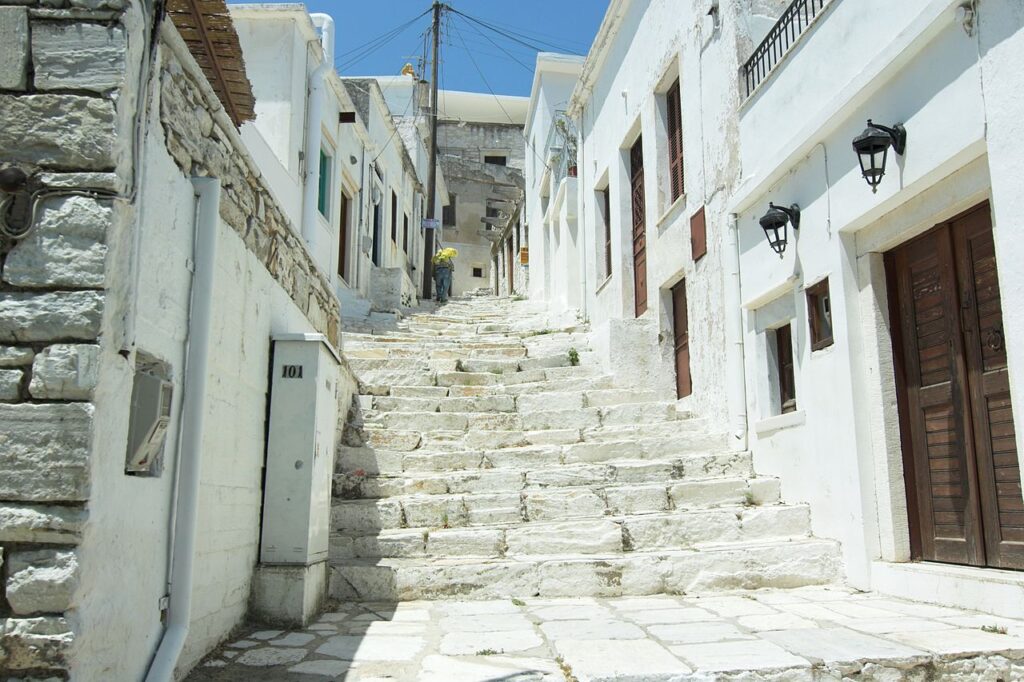
Historical background
The white landscape is neither an ancient tradition nor something that characterizes all of Greece. It was in the Cyclades that whitewashing gradually came to dominate the landscape. Through a combination of practical everyday needs, state sanitation, policies during the dark years of dictatorship, and growing tourism, the image we know today eventually took shape.
According to the common narrative, the houses of the Cyclades began to be whitewashed during a cholera epidemic in the 1930s. Equally widespread is the story that the military junta later ordered them to be painted blue and white to resemble the Greek flag. Both claims have been repeated so often that they have almost become accepted truths.
The houses of the Cyclades were not always white
Long before any government regulations were introduced, houses were whitewashed for purely practical reasons. Slaked lime, ασβέστης/asvéstis, was cheap, easy to apply, and reflected the scorching sun. Its strongly alkaline properties also made it useful for hygiene and disinfection.
But that does not mean the older villages were the dazzling white environments we associate with the Cyclades today.
Ochre and earthy red tones often appeared alongside whitewashed surfaces, while other houses left the local building stone exposed. Shades of blue could be created by mixing the lime with λουλάκι/louláki, the same pigment used in laundry to make white fabrics appear brighter.
The result was much more varied architecture, often shaped by materials that were locally available and easy to obtain.
It was not only the colors of the houses that looked different. Many of the old communities of the Cyclades were built far from the coast, high on mountain slopes or behind natural shelter.
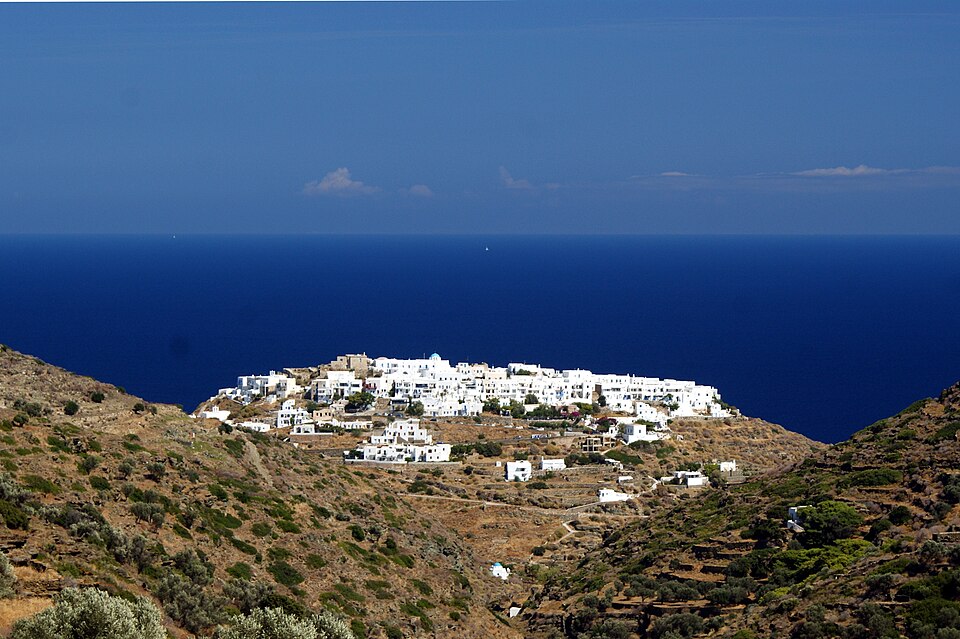
Why the villages ended up there – and what role centuries of pirate threats played – is another story, one we’ll return to in the next part of our series on the houses of the Cyclades.
The role of sanitation during difficult times
The major shift came in the late 1930s, when Greece had already endured years of economic crisis, political unrest, and war. Out of this political turmoil emerged General Ioannis Metaxas, who seized power in a military coup.
In a tense society where poverty and unrest made epidemics easier to spread, disinfecting lime became an inexpensive tool in the state’s public health policy. The regime made whitewashing compulsory on the islands for sanitary reasons.
But was it really, as is commonly claimed, a cholera epidemic that prompted Metaxas to require whitewashing?
That detail often appears in popular accounts, but the evidence for that specific claim is weaker than for the whitewashing requirement itself. What is certain is that the measure had a sanitary purpose, regardless of which particular disease concerned the authorities most.
After the war, white began to take on another meaning. It was no longer only about hygiene, but also about aesthetics and a national identity increasingly linked to tourism.
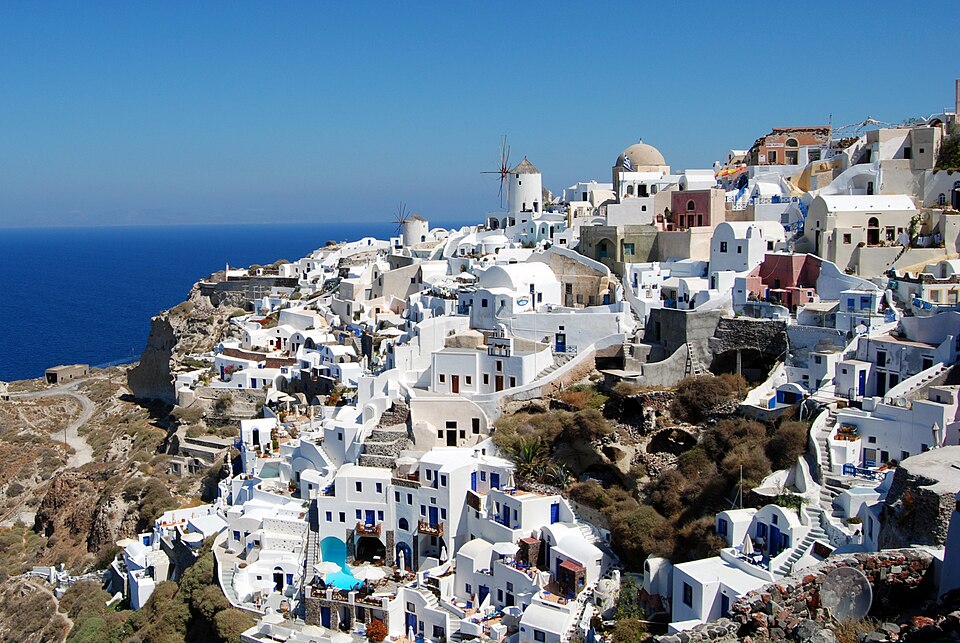
There is a well-known anecdote in academic research on the subject that, in the 1950s, Queen Frederica supposedly showed the prime minister photographs of whitewashed houses on Mykonos and suggested that they could become a symbol of Greece abroad. The anecdote has been described as an urban legend, but true or not, it captures something real: by this time, the white houses of the Cyclades were already being actively used as a brand.
The white houses thus began to acquire a value far beyond the Cyclades themselves: an easily recognizable image of the entire country, presented to the emerging international tourism market.
Later, in the 1970s, under the military junta, the state moved from public health measures to outright aesthetic control. It was no longer just about hygiene. The authorities wanted to create a uniform Cycladic appearance. Polychromy was discouraged, and white became the dominant color for facades.
Another widely repeated claim is that houses were ordered to be painted blue and white to resemble the Greek flag. The evidence, however, points almost exclusively to the junta’s requirements concerning white. Blue seems instead to have continued as a local tradition on doors and shutters, rather than as a government mandate.
After the fall of the dictatorship, much of this standard remained in place as the democratic state began protecting traditional settlements and their architectural character. At the same time, modernist architects had already begun to see the white Cycladic forms as something almost primordial: pure, simple, timeless.
Mass tourism completes the circle
The increase in international travel after the war turned the white houses against the blue sea into the very image of Greece — and because that image spread so successfully, many soon came to believe that it applied to the country as a whole, not just the Cyclades.
The more tourists expected to see white villages, the more buildings were whitewashed to meet those expectations — a self-reinforcing cycle in which the image eventually took the place of reality.

Toward the end of the 20th century, regulation continued through specific rules for many of the Cyclades’ traditional settlements, not least several of the islands’ main villages, known as Chora. White could still be the norm there, but the rules also took greater account of local architecture, so the result did not look the same everywhere.
Ermoupoli on Syros is a clear example, with its colorful neoclassical urban architecture, while the mountain village of Apeiranthos on Naxos is characterized by local stone and marble rather than whitewashed facades.

Outside the Cyclades, the landscape looks different. Crete, the Peloponnese, Epirus, and the Ionian Islands have their own building traditions, materials, and colors. But as tourism developed, the familiar Cycladic white began to appear elsewhere as well, especially in tourist resorts. Local traditions remained, but were often complemented by the image of Greece that visitors already knew from postcards and travel brochures.
A white heritage – with many nuances
So who painted the houses of the Cyclades white? There is hardly a simple answer. Lime had been used there long before the regimes of the 20th century, but it was during the last century that white gradually went from a practical tradition to a rule, an ideal, and finally an international symbol.
Today, the image is so powerful that the white houses often come to represent all of Greece – even though they do not tell the whole story, even of the Cyclades themselves.
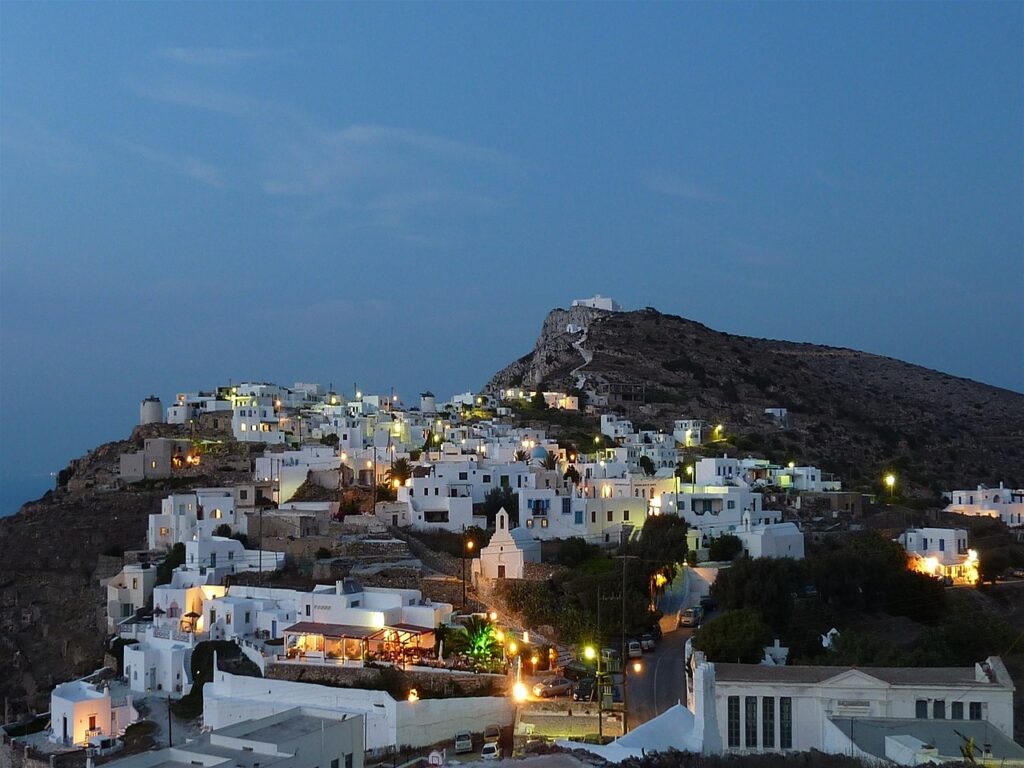
Behind the white surface are older colors, local materials, and communities shaped by very different needs from those reflected in today’s postcards and vacation photos. The older Cycladic houses were often built to blend into the landscape – and many of the islands’ traditional settlements still lie surprisingly far from the ports and beaches that are now centers of life and tourism.
Why were the villages built up there? Don’t miss the next part of our series on the Cyclades, where we explore concepts such as Chora, Kastro, old ports, and centuries of pirate threats.
Sources
Myrto Stenou, NTUA – Heritage
Greek Parliament – Foundation for Parliamentarism and Democracy
Wikipedia – Antibacterial properties of lime
University of Edinburgh – Katerina Mitka, Greek Tourist Landscape
Related articles
On the island of Amorgos, a future is being built with the stones of older times
The Greek islands between the 16th and 20th centuries
Amorgos – a gem in the big blue