
Traveling through Hades and trying to picture the underworld of ancient Greek mythology is no easy task. In this fourth part of our series on mythology’s strange and overlooked aspects, we once again encounter varying accounts. Sources and traditions differ on rivers, places, and routes, and sometimes the stories blend. There is no single, definitive map of the realm of the dead. But that should not stop us from setting out.
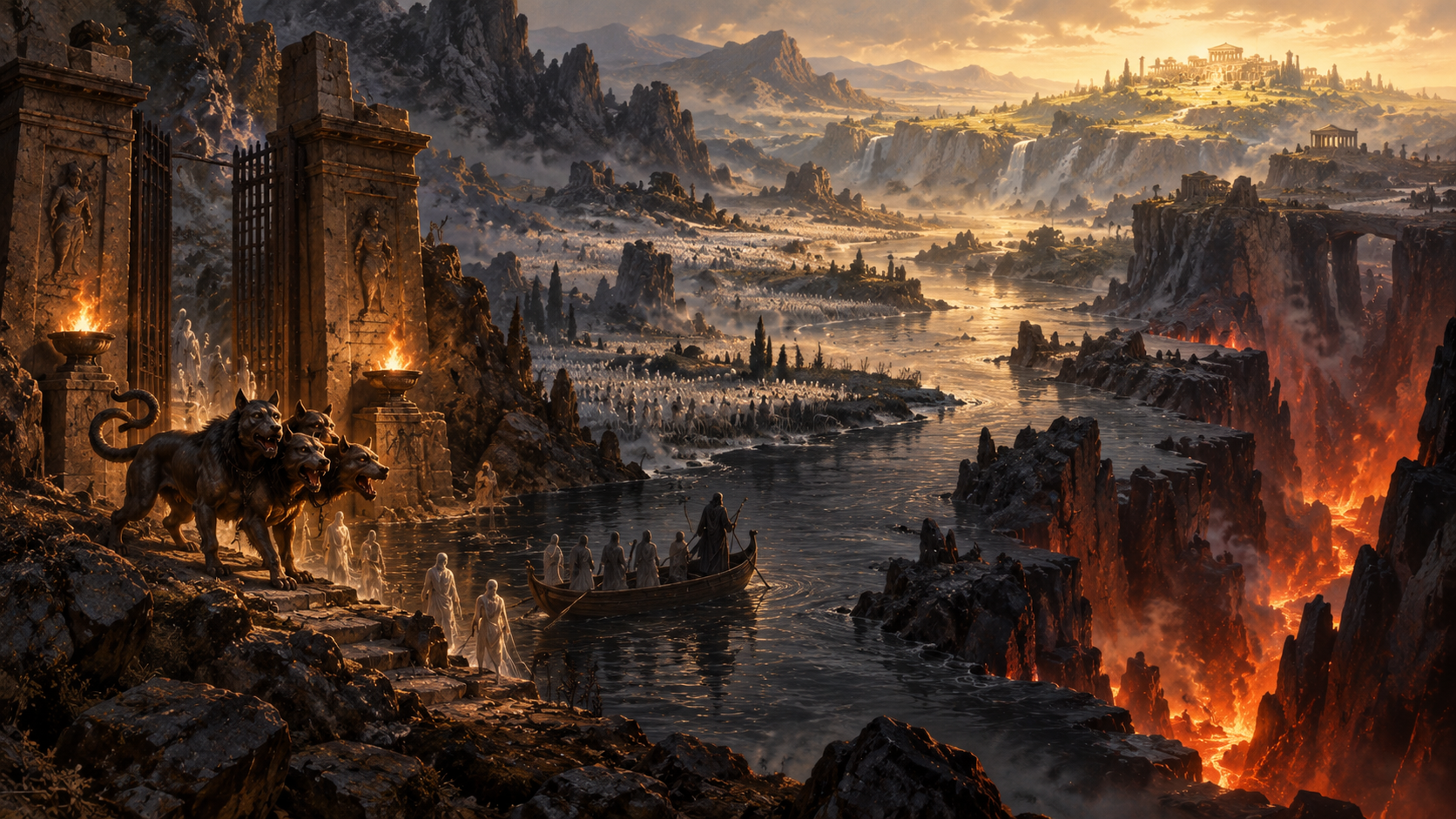
As promised, today we will make our way past Cerberus, the enormous, many-headed dog guarding the gates of the realm of the dead. He looks terrifying, but greets us kindly and lets us pass. His friendliness is a sly trick: everyone is welcome in, but no one is allowed out. Only when someone wants to leave does Cerberus reveal his true temper.
Beyond the gates lies Hades, the realm of the dead, where the sun never reaches. Hades is also the name of the god who rules here with his queen, Persephone.
Hades is the brother of Zeus and Poseidon, but is not usually counted among the twelve Olympian gods. He is hardly a minor god, though: he rules over the dead and is one of the most feared figures in the divine world.
In Greek mythology, he was also called Plouton, “the wealthy one.” His wealth included both the metals within the earth and the life that sprouts beneath the ground, where the seed waits to return to the light. Among the Romans, the name became Pluto.
Guided through Hades by Hermes
As we continue our walk through the realm of Hades and Persephone, we soon spot a curious procession. Hermes, the messenger of the gods, appears here as ψυχοπομπός (psychopompós), the guide of souls. With his golden staff, he leads a crowd of souls onward.
The dead follow him, clustered closely along the rocky path. Homer compares them to bats in a cave: clusters hanging from the cave ceiling, squeaks and fluttering wings in the darkness. So, too, do the souls in Hades travel, squeaking and fluttering after their guide.
The souls we meet have already made a strange journey. Homer tells us how they have passed Oceanus, the vast river encircling the world, and continued beyond the gates of the sun, associated with sunset in the west. They have also passed δήμος ὀνείρων (demos oneiron), the land of dreams, which lies along the way to the realm of the dead.
The Greek poet and Nobel laureate Giorgos Seferis renders this passage from the Odyssey as follows:
“They passed the gates of the sun and the world of dreams and soon reached the Asphodel Meadow, where the souls dwell”
(Free translation from the Greek.)
The Asphodel Meadows and Charon
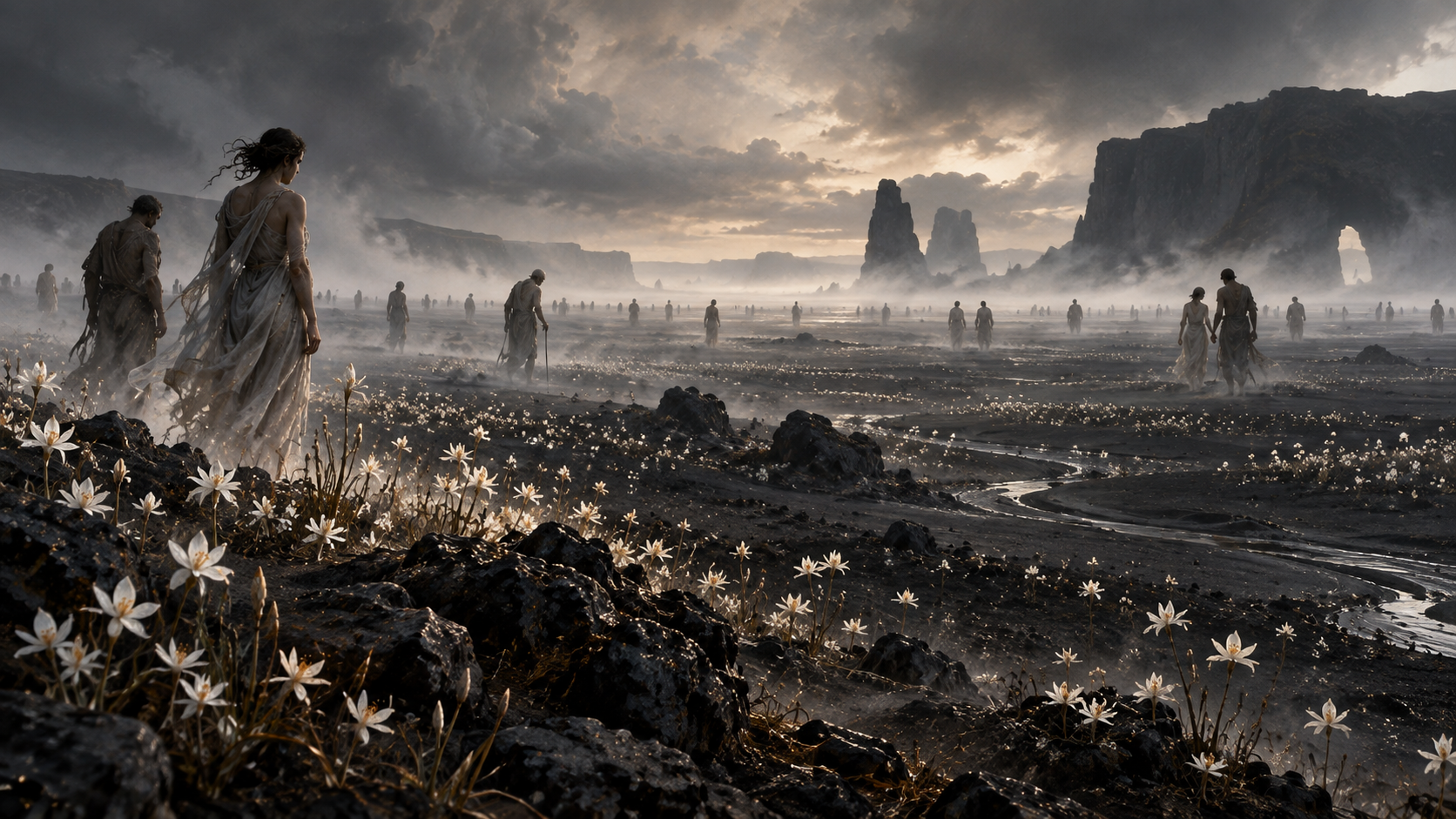
Imagine vast meadows of asphodels, with pale, almost white flowers on tall stems. This is where most of the dead dwell. Among them are ordinary people as well as former heroes. It is among these shades that Odysseus, during his visit to the realm of the dead, finds several of his old comrades in arms, including Achilles. They all wander aimlessly as pale, shadowy figures, in a timeless and desolate existence.
Farther away, reeds line a stretch of dark water. A rowboat approaches the shore. It serves as a ferry between the worlds of the living and the dead.
Charon, the ferryman, is depicted in different ways in Greek mythology. On older vases, he appears as a rough, unkempt sailor. In later depictions, his features sometimes become gentler and more refined. He often wears a simple tunic and a pointed cap.
In the work of the Roman poet Virgil, we meet a more terrifying figure: a filthy old man with a tangled white beard and eyes that glow like fire.
In some accounts, Charon is both old and impatient: passengers must hurry aboard.
The crossing costs a small coin, an obol. That is why the dead were often buried with money for the journey.
Even death’s final journey requires someone to remember the ticket.
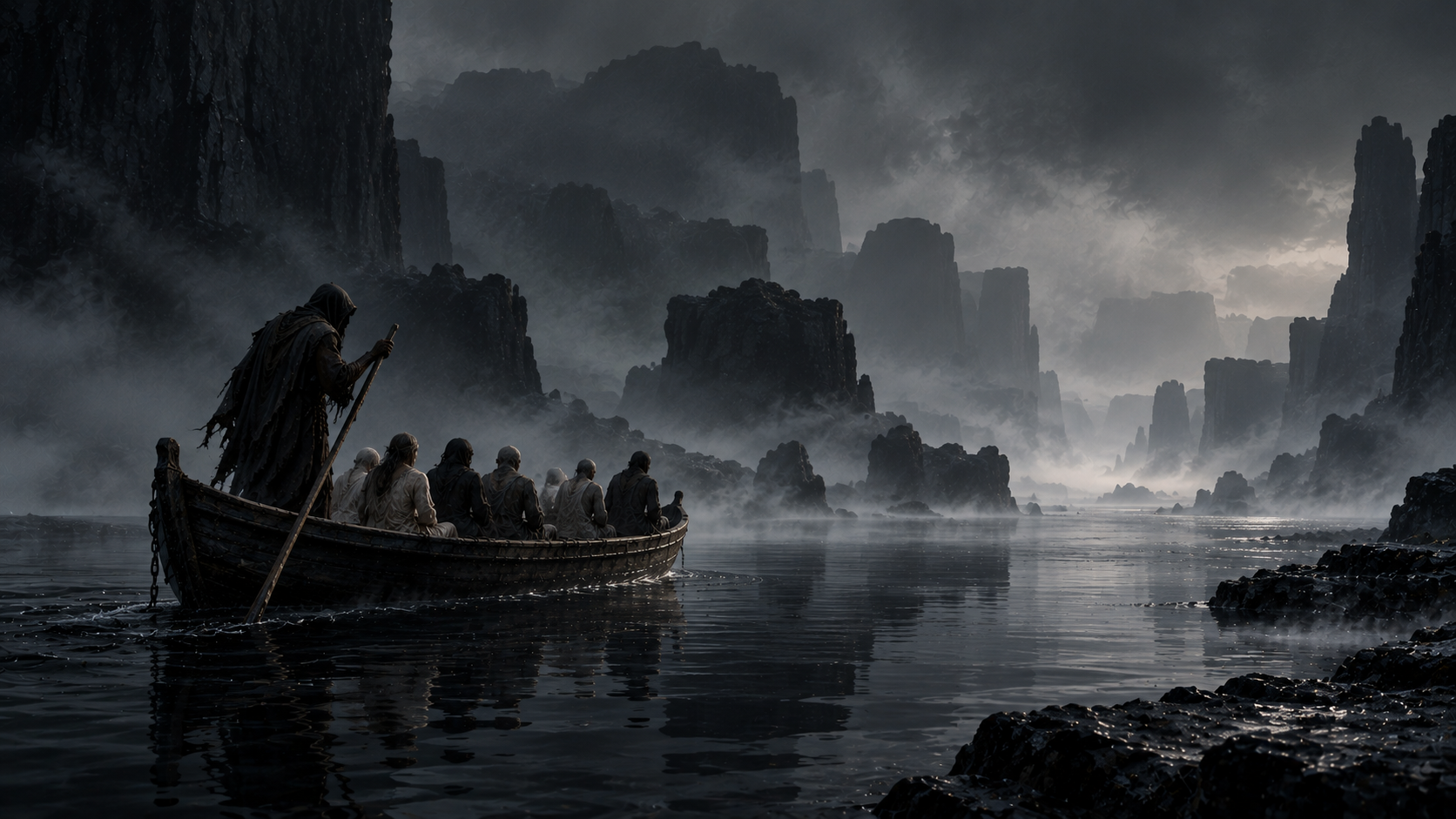
But which waters does Charon cross in his gloomy boat?
Some stories say the River Styx, with pitch-black, sluggish water and mist rising from its surface. In some accounts, the river coils nine times around the realm of the dead, keeping the dead confined. It is also the river by which the gods swear when making their most binding promises.
Others have Charon row across the River Acheron, associated with sorrow and pain. Even in antiquity, the river was linked to the road to the realm of the dead—and it can still be visited in Epirus in northwestern Greece.
Flaming waters, forgetfulness, and three stern judges
Farther into Hades, we encounter more streams and tributaries:
- Cocytus, the river of lamentation, whose name evokes wailing and sorrow.
- Pyriphlegethon, the flaming river, flows through fiery regions where water and mud boil in a vast lake of fire. In some accounts, it surrounds Tartarus like a burning moat.
- Lethe offers something quieter. Its name means forgetfulness, and anyone who drinks its water forgets their former life. Faces, home, and worries vanish from memory.
The great River Styx calls for particular caution. By its waters, the gods swear their binding oaths. If a god breaks a promise, they are deprived of breath and voice for an entire year, during which they may taste neither nectar nor ambrosia. This is followed by nine years of exclusion from the other gods’ feasts and councils.
Immortality apparently exempts no one from the consequences.
Our walk through Hades now brings us to a crossroads. Three imposing figures await us there, three judges, each holding a scepter. Before them, the dead gather and wait, without clothes, possessions, or companions.
Here, the next stage of their journey is decided. The judges examine how they have lived: who deserves a happy existence, and who must atone for their crimes? Beyond this boundary, no one can hide behind wealth or noble birth.
The three judges are Minos, Rhadamanthus, and Aeacus. All three were kings on earth, known for their justice and their laws. Their father Zeus therefore gave them the task of judging the dead. Minos has the final say when the others are uncertain.
Minos also gave his name to the entire Minoan civilization on Crete—a term coined in modern times.
Tartarus, the dreaded abyss
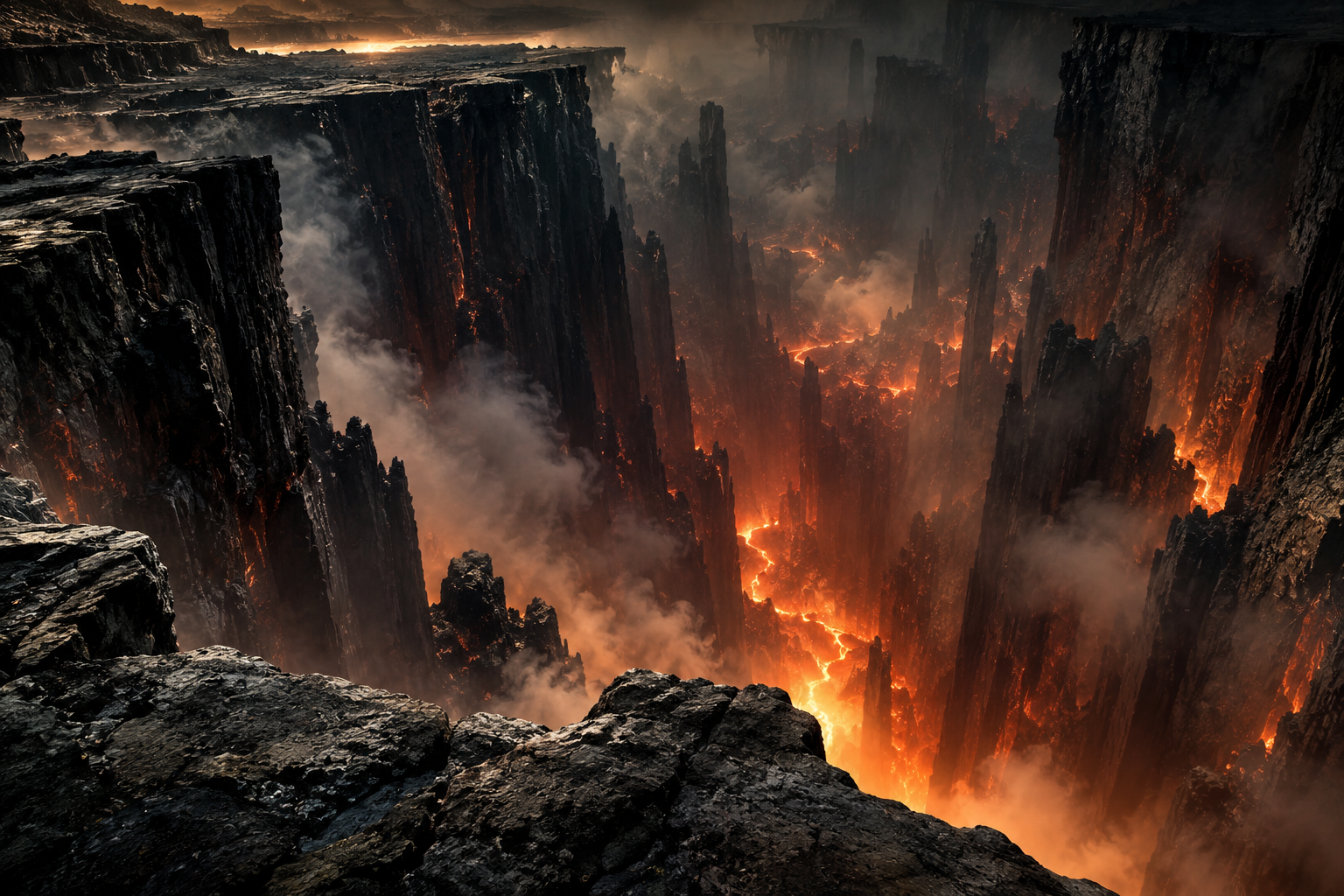
Farther ahead, the abyss opens into Tartarus. Down there, the Titans, the defeated gods of the older generation, are imprisoned behind bronze gates. In some stories, the River Pyriphlegethon surrounds Tartarus like a burning moat. Other stories also place humans here, punished for grave crimes or arrogant attempts to defy the gods.
Sisyphus, who tried to cheat death, is forced to roll an enormous boulder uphill. Every time he almost reaches the top, the stone rolls back down, and the work begins again. This gives us the expression “a Sisyphean task”: endless toil that never produces a lasting result.
But how far down is Tartarus? An ancient account gives us a dizzying measure of its depth:
Drop a bronze anvil from the earth’s surface. Let it fall through the night. Nine days and nights pass, and still it falls. Only on the tenth does it reach Tartarus.
We stop at the edge of the abyss and cautiously peer down.
The Elysian Fields
We leave Tartarus and head toward a brighter region glimpsed in the distance:
Elysium, the blessed fields. Not all the dead are consigned to a shadowy existence in the Asphodel Meadows. Some stories allow those who have lived righteous lives to enter Elysium and enjoy a happy existence after death.
Here, pleasant west winds always blow, sparing the plains snow, winter storms, and lashing rain.
In the Odyssey, King Menelaus is promised that he will be brought here without first having to die. He is married to Helen and is therefore Zeus’s son-in-law. Family connections could apparently help even with one’s final place of residence.
The location of Elysium also varies in Greek mythology. Some stories place the blessed fields at the edges of the world of the living. Others make them part of the realm of the dead itself.
Returning from Hades
We are still in the realm of the dead. But is there a way back to the living? There are, in fact, a few who have managed to return from Hades.
Hades permitted Heracles to bring Cerberus up to the world of the living, on condition that he defeated the dog without weapons. After completing the task, Heracles brought Cerberus back to the underworld.
Among mortals, Orpheus managed to return, but without his beloved Eurydice. Sisyphus also tricked his way back to the world of the living, but eventually had to return to the realm of the dead, where his eternal punishment with the boulder awaited.
In his work The Republic,, Plato has a fallen soldier named Er return from the realm of the dead. As his body lies on the funeral pyre, he awakens—and begins to describe what he has seen on his journey through Hades.
Among other things, he tells of souls gathering after a thousand years of reward or punishment. Before them, the herald of the Fates lays out patterns of different lives, and each soul chooses a pattern to follow in the next life. Before their coming rebirth, they drink the water of forgetfulness and lose all memory of what has gone before.
We have now spent a long time traveling through the realm of the dead. The old stories have taken us across flowering meadows, along rivers of fire, past stern judges, and to souls choosing how they wish to be reborn.
We leave the water of forgetfulness alone—we do want a story to tell when we get back.
All that remains now is to find our way back to the gates of Hades. Cerberus is waiting there.
His snake-like tail has stopped wagging.
Sources
- Homer, Odyssey, Book 4, lines 561–569 – Elysium.
- Homer, Odyssey, Book 24, lines 1–14 – Hermes and the journey of the souls, with Seferis’s translation.
- Hesiod, Theogony – Cerberus, Tartarus, the bronze anvil, and Styx.
- Theoi, Charon – Ancient texts and depictions, including Pausanias’s description.
- Plato, Gorgias 523–524 – The judgment of souls, excerpt on Theoi.
- Plato, The Republic, Book 10 – The story of Er.