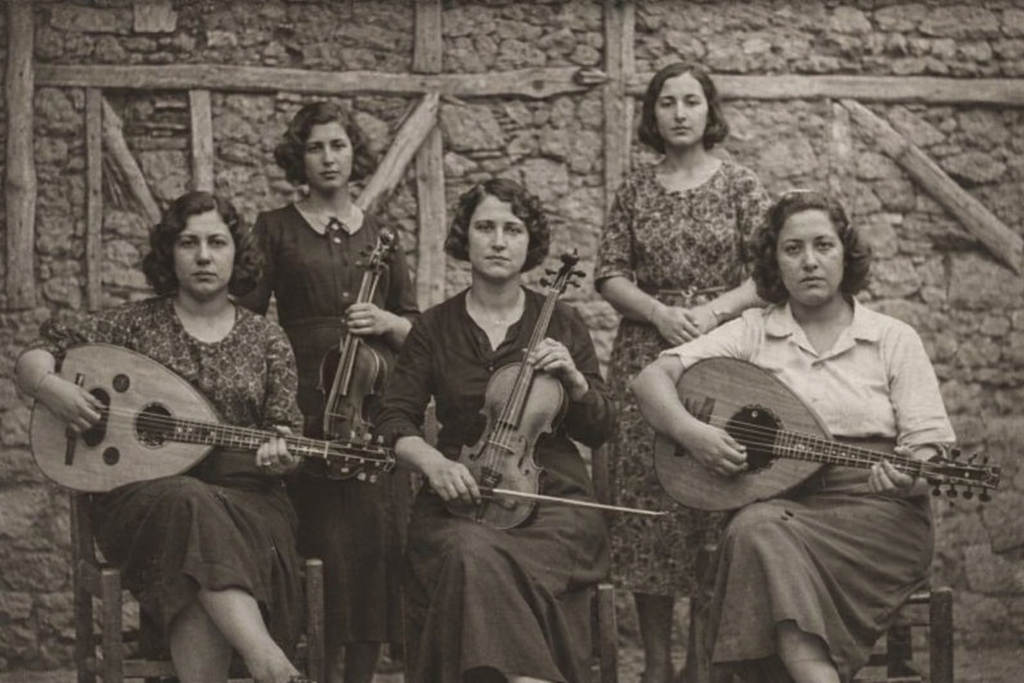
Today, we’ll take a closer look at some of the women of rebetiko who helped shape and spread the music far beyond Greece’s borders.
The history of rebetiko is often told through its great male figures. But the genre was also shaped by women who lived and worked in the same world as their male counterparts.
From the café-amans of Smyrna and Constantinople to tavernas and recording studios in Athens, female artists were an integral part of the tradition that would later come to be known as rebetiko. They carried with them experiences of migration, hardship, resilience, and love. In doing so, they left a lasting mark on the music and helped carry it far beyond Greece.
This article highlights eight of these voices. Together, they offer another way into rebetiko – and tell a story that often remains in the shadow of the more familiar male names.
Marika Papagika (Μαρίκα Παπαγκίκα)
Marika Papagika was born in 1890 on the island of Kos and grew up in a world where Ottoman and Greek cultures met. Her family first emigrated to Alexandria and later to the United States, following a path taken by many Greeks in the early 20th century.
In New York, she became a pioneer when she began performing in one of the city’s first café-amans. Through her recordings, she carried the Smyrnaic singing style across the Atlantic and helped Greek-American communities maintain a connection to their cultural roots.
Papagika recorded hundreds of songs and is considered one of the earliest female voices in rebetiko to be preserved on record. Despite her importance, she never returned permanently to Greece and died in New York in 1943. Her recordings remain an important part of the early musical life of the Greek diaspora in America.
What is a café-aman?
Café-amans were popular music cafés in cities of the Ottoman Empire during the late 19th and early 20th centuries, especially in Smyrna and Constantinople. Small ensembles of singers and instrumentalists performed there, often improvising songs with Eastern-influenced melodies and long, melismatic vocal lines.
Audiences would respond with the exclamation “amán, amán”- an expression of emotion and participation – which also gave these venues their name. The atmosphere was cosmopolitan, attracting Greeks, Turks, Armenians, and Jews alike. Many of the singers who later became known in rebetiko began their careers on these stages.
Rosa Eskenazi (Ρόζα Εσκενάζυ)
Rosa Eskenazi, born Sarah Skinazi in Constantinople around 1897, grew up in a Sephardic Jewish family and spent her early years between Constantinople and Thessaloniki. She began her career as a dancer and singer, quickly developing a stage style where Eastern melodies met Byzantine and Greek musical traditions.
When she arrived in Athens in the 1920s, she was discovered by the composer Panagiotis Tountas. During the 1920s and 30s, she recorded hundreds of songs and became the first true female star of rebetiko.
Rosa Eskenazi toured throughout the Eastern Mediterranean, and her voice remains closely associated with port cities like Piraeus and Thessaloniki. She continued performing well into the 1970s and is today regarded as one of the greatest women in rebetiko and one of the genre’s most iconic voices.
The educated refugee musicians
Among the hundreds of thousands of refugees who arrived in Greece after 1922 were also many experienced musicians from cities such as Smyrna, Constantinople, and other cosmopolitan centers of the Eastern Mediterranean. Many were already highly skilled instrumentalists and composers.
In Piraeus and Athens, they encountered the rebetes of the port districts. As these worlds began to merge, a new kind of music emerged, combining the raw bouzouki tradition with more developed arrangements and compositional techniques. Many of these musicians later went on to work for the major record labels. Composers such as Panagiotis Tountas, Spyros Peristeris, Kostas Skarvelis, and Dimitris Semsis wrote some of rebetiko’s most enduring songs and helped carry the music far beyond its original settings. It was, for example, Spyros Peristeris who encouraged Markos Vamvakaris to sing his own songs, something that would prove decisive for the development of the genre.
Rita Abatzi (Ρίτα Αμπατζή)
Rita Abatzi was born in Smyrna in 1914 and arrived in Athens as a refugee after the Asia Minor Catastrophe of 1922. She began singing in small tavernas in Faliro and quickly gained attention for her powerful, slightly raw voice.
During the 1930s, she became one of the most recorded female singers in Greece, appearing on hundreds of recordings. Abatzi performed both the Greek song tradition from Asia Minor and the emerging rebetiko of Piraeus’ port districts. She collaborated with several of the era’s leading composers, including Panagiotis Tountas and Vassilis Tsitsanis.
Today, her recordings offer a vivid glimpse into the experiences of the refugee generation in Greece during the interwar years.
Stella Haskil (Στέλλα Χασκίλ)
Stella Haskil was born in 1918 in Thessaloniki into a Sephardic Jewish family. She moved to Athens shortly before the German occupation during World War II. During the war years, she performed in small clubs in Omonia and lived under difficult conditions while many of her relatives were persecuted.
After the war, her career took off and she became one of the leading female voices in rebetiko. In just a few years, she recorded more than a hundred songs. She collaborated with some of the era’s most important composers, including Vassilis Tsitsanis, Apostolos Kaldaras, and Markos Vamvakaris.
Haskil’s career was tragically short. She died of cancer in 1954 at the age of just 36, but her recordings are today considered part of the classic rebetiko repertoire.
Marika Ninou (Μαρίκα Νίνου)
Evangelia “Marika” Atamian was born in 1922 on a ship carrying her Armenian family from Smyrna to Piraeus after the Asia Minor Catastrophe. She grew up in the refugee district of Kokkinia and began performing at an early age alongside her husband in an acrobatic stage act.
After the war, she turned to singing and adopted the stage name Marika Ninou. The guitarist Manolis Chiotis discovered her voice, and in 1948 she made her first recordings. When she joined Vassilis Tsitsanis’ orchestra in 1949 at the famous tavern “Tzimi tou Chondrou” in Piraeus, she quickly became one of rebetiko’s most beloved voices.
Her powerful and dramatic singing style made her a defining figure of postwar rebetiko. She died tragically young in 1957 at the age of just 35.
Ioanna Georgakopoulou (Ιωάννα Γεωργακοπούλου)
Ioanna Georgakopoulou was born in 1920 in Pyrgos on the Peloponnese but moved to Athens at an early age. She was discovered as a teenager while singing in the church choir at Agios Pavlos and began recording at just 18. Her elegant voice quickly made her sought after, and she collaborated with composers such as Vassilis Tsitsanis, Giorgos Mitsakis, and Manolis Hiotis.
Georgakopoulou also wrote her own songs, something that was uncommon for female artists in rebetiko. Her most well-known composition is Trelé Tsigane.
Eftychia Papagianopoulou – the woman behind many of the well-known songs
Not all the women who shaped rebetiko stood on stage. One of the most important was the lyricist Eftychia Papagianopoulou (1893–1972). She was born near Smyrna and came to Greece as a refugee after the upheavals around 1922.
Eftychia wrote the lyrics to many of the most beloved songs in Greek music and collaborated with composers such as Vassilis Tsitsanis, Apostolos Kaldaras, and Manos Hadjidakis. Among her best-known lyrics are Τα καβουράκια (Ta kavourákia), Δυο πόρτες έχει η ζωή (Dyo portes echi i zoi), and Είμαι αετός χωρίς φτερά (Ime aetos horis ftera).
Despite her immense influence, she long remained in the shadow of the artists who performed her songs. It was only after her death that her importance to Greek music began to be fully recognized.
Sotiria Bellou (Σωτηρία Μπέλλου)
Sotiria Bellou was born in 1921 near Chalkida and had a dramatic youth marked by conflict and political engagement. During the German occupation, she joined the resistance and was tortured by the Gestapo. After the war, she established herself as one of the most powerful voices in rebetiko and worked closely with Vassilis Tsitsanis. Bellou is especially associated with some of the genre’s most iconic songs, including the well-known Συννεφιασμένη Κυριακή (Synnefiasméni Kyriakí).
She also became a symbol of personal freedom and defiance within Greek musical culture. Bellou continued performing well into the 1980s and passed away in 1997.
Marió (Μαριώ)
Maria Konstantinidou, known as Marió, was born in 1945 in Thessaloniki and belongs to the generation that carried rebetiko into the present day. She began performing as a child alongside her father, who was a musician, and learned to play the accordion at an early age. As a young girl, she heard Rosa Eskenazi sing and decided to devote her life to rebetiko.
Since the 1960s, she has performed with both older masters and younger musicians and is regarded as one of the last classical female voices of rebetiko. Based in Athens, she remains closely connected to the tradition, often appearing on smaller stages where the music still lives on.
The women of rebetiko who shaped the genre
Most people who discover rebetiko first encounter its great male figures – Markos Vamvakaris, Vassilis Tsitsanis, Giorgos Batis, and others whose names have become almost synonymous with the genre.
But the women of rebetiko were an integral part of this world, even if their names have often remained in the shadow of their more well-known male counterparts. On stage, in the studio, and on record, they helped shape the music’s expression and gave voice to the experiences that define so many rebetiko songs.
They all sang about the same kinds of lives – love, loss, migration, everyday struggles, and survival.
When listening to their recordings, a richer picture of the genre emerges. Not just as the story of a few legendary male musicians, but as a musical tradition and way of life in which female artists also left a clear and lasting mark on both the stage and the repertoire.